

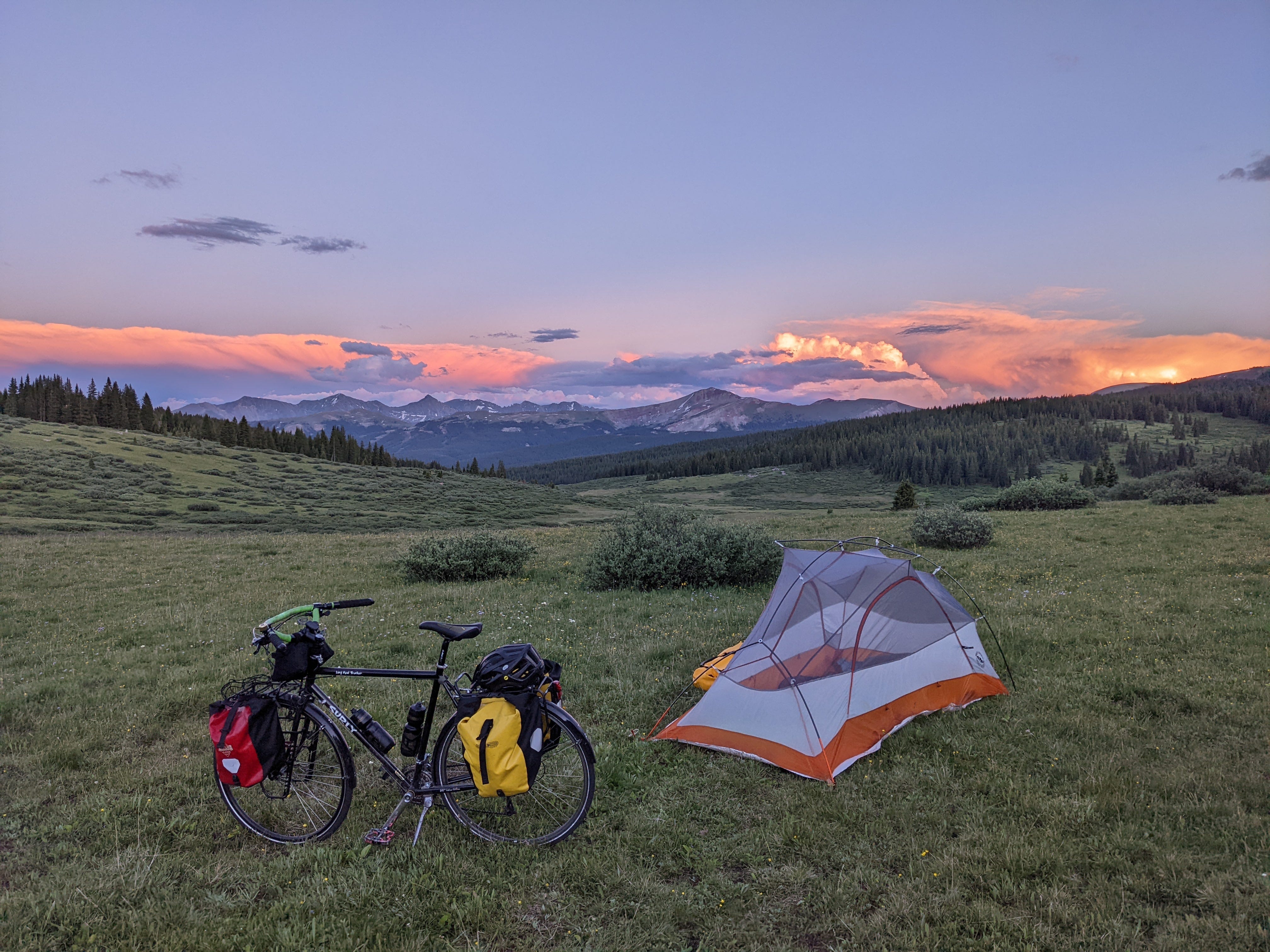
Back in 2022, while cycling through Colorado, I started listening to The Psychology of Money by Morgan Housel.
I was pushing slowly up Vail Pass when Morgan’s book convinced me to undertake a financial experiment: I would put a chunk of my savings into a high-growth index fund, and then completely ignore it.
Over the next 10 months I purchased $2000 of Vanguard Growth ETF each month, leading to a $20,000 basis. I clicked “‘reinvest dividends,” and then I totally ignored it.
In the following four years, that $20,000 grew into $44,000.
On one hand, I felt great. Free money!
On the other hand, I felt weird. Where, exactly, did this money come from?
From an economist’s point of view, I earned it. I risked capital. I deferred consumption. I invested my money in a bunch of enterprises that used it to become slightly more “productive,” whatever that means (I surely contributed to improving some weapons systems and streamlining some coal mining operations).
From another point of view, what did I really do? I was cycling, dancing, writing, and traipsing around Europe during those four years. I did not labor to improve anyone’s life in exchange for $24,000. That’s a chunk of money that most people in the world must work very, very hard to accumulate. All I did was work (quite happily) to earn the original $20,000, and then I clicked a few buttons.
I only began seriously saving money in my 30s, and it’s mostly languished in boring savings accounts.1 I do have a Roth IRA, but that’s reserved for “Old Blake” (as the account is titled). I have not played the stock market in any way that contributes to my present-day consumption… until now. The $20,000 experiment was my first brush with pure, unadulterated, capital gains. And I gotta say, it feels weird.
Not to get all Thomas Piketty here, but experiencing the “return on capital” versus “return on labor”—and knowing that these earnings are taxed at just 15%, or in my case, 0%2—makes me realize how tilted the world is toward capital owners.
The same goes for real estate, which I’ve never owned. While I’m happy for some of my friends and family to have realized large gains in their property values—where exactly does that “value” come from? If you can pull $100,000 out of your home equity and use that to purchase real food, real plane tickets, real healthcare, and other scarce products and services—who generated that value? To what extent is your good fortune linked to the modern crisis of affordable housing? To what extent is it a transfer from the young to the old, from the future to the present, or from other nations to ours?
If the economic pie is truly expanding, then yes, we can all have more food, plane tickets, healthcare, and housing. If not, then we’re in some sort of casino. Did I just play roulette, and win?
This is such a vast, complicated, and fascinating topic—and there’s such a big difference between grasping it abstractly versus concretely. Many die-hard redistributionists have surely changed their tunes after watching their homes double in value in five years or their index funds go up, up, up!
Which brings me back to the concrete, here-and-now question: What should I do with this money?
One part of me says, “leave it there, you fool!” It will only grow bigger in the long run, right? But as you know, I’m not a member of the cult of retirement. Some future-deferral is appropriate; too much is unhealthy.
Another part says, “give it away to those who need it most!” That’s the effective altruist in me. I’ve donated to organizations like GiveWell in the past, and if I die unexpectedly, my will stipulates that my assets will go in that direction. But I also struggle to feel like modest donations really make a difference in this domain.
Yet another part says, “give it to someone working toward a cause you admire!” Last year I contemplated cashing out the fund and giving a bunch of $1000 grants to young writers who are promoting the dirtbag rich ideals of high freedom, low income, and deep purpose—sort of like my own, tiny version of the MacArthur Genius Grant. But I feared the conflict of interest and personal bias inherent in making such decisions.
Then, while running my favorite trail in South Lake Tahoe last week, chewing on the question of “what responsibilities come with receiving wealth that arrives disconnected from labor?”, I made my decision.
Of the $24k in appreciated gains, I decided to leave half in the fund. The other half—$12,000—I cashed out.

I love round, symbolic numbers. This summer, which I’m spending cycling the Western US, marks four years since I cycled in Colorado and began this experiment. $12,000 is exactly half of the total appreciation. And there are twelve months in the year.
I decided that I’d try to do something good—in a way I can clearly identify and verify—with $1000/month for one year.
This thing would also be a bit self-serving.
And here’s the fun part: It’s something you can get involved with.
I decided to teach people how to play group games.
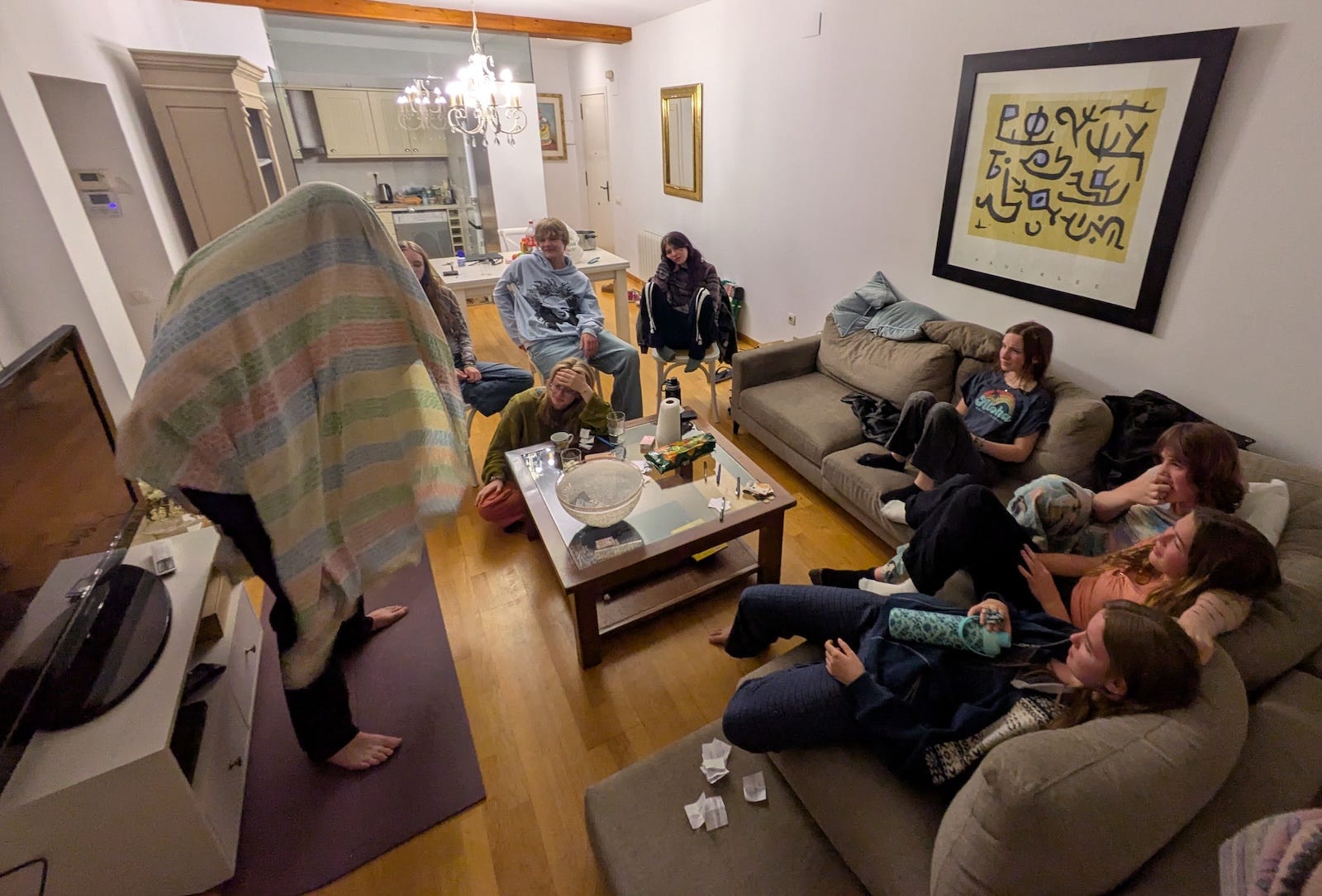
If you work in outdoor education long enough, you start accumulating games. Icebreakers. Name games. Getting-to-know-you games. Improv comedy games. Verbal games. Movement games. Big, crazy, summer-camp-energy games.
Do enough partner dance, and you start accumulating other kinds of games. Physical warm-ups. Body awareness activities. Partnering games. Consent games.
And if you venture into the wilderness of modern relational practices3, you end up with a treasure trove of “connection games”: ones purposefully designed to promote vulnerable sharing, powerful introspection, and deep group bonding.
This is my story. Since 2003 I’ve spent something like 20,000 hours working at summer camps, facilitating outdoor education, and running my Unschool Adventures trips. Over the past decade, I’ve gone deep into partner dance. And more recently, I’ve become familiar with “authentic relating” and its many excellent connection games.
And here’s something I’ve observed: All group games have the potential to be connection games, if you approach them the right way.
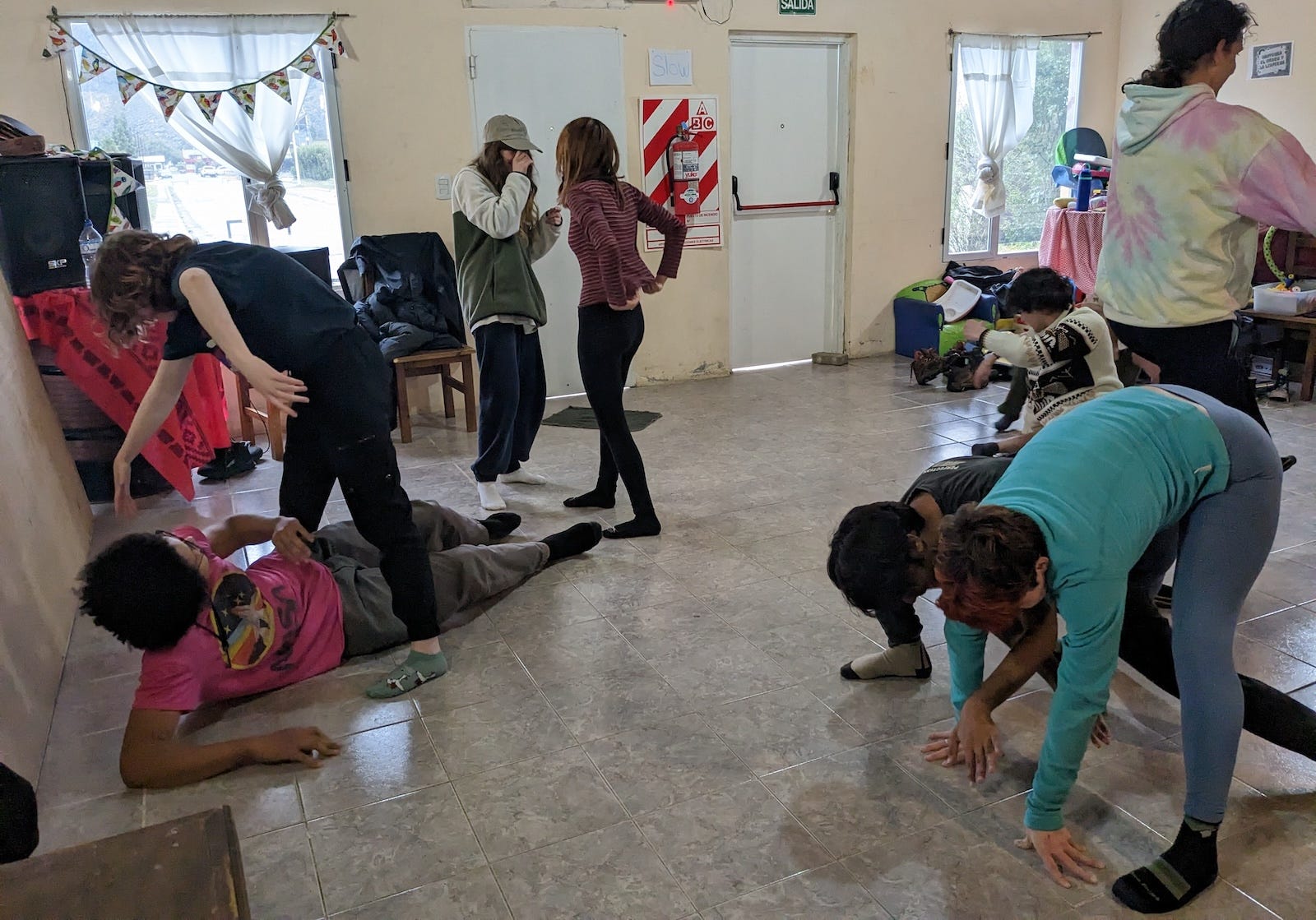
Group games aren’t just for little kids, theater geeks, corporate team-building retreats, or lonely people who don’t know how to socialize. They are methods for breaking through boredom, distraction, and ingrained patterns. They put people of all ages into a playful, open mindset. They get us moving, laughing, and focusing. And most impressively, they get people of all ages to put their phones down and joyously pay attention to each other for a few, precious minutes.
Some group games are silly. Some are serious. Some are sacred. And unlike card games, board games, or video games, these games require active facilitation. They need a guide. When the guide does a poor job, group games can feel tedious, frustrating, and exclusionary. But done well, even the silliest games can lead to a powerful sense of connection between individuals, within oneself, and among groups.
Something else I’ve learned is that finding good group games is hard. There are essentially no comprehensive books or online collections of games that are connection-oriented.4 When you do find one, you often need someone to model the facilitation, because simply reading “the rules of the game” doesn’t cut it.
For all these reasons—and because I’m a nerd about these things—I started cataloging my favorite group games: ones I’ve used repeatedly on trips, at camps, and with friends. Of the hundreds of games I’ve encountered over the years, there were about 50 that really stuck.
I began scheming how I might share some of these games in an organized way. I drafted a small-group online training called Silly to Sacred, sent it out for feedback, and learned that while many people were hungry for such a training, few were ready to spend the ~$300 I’d want to charge to make it worth my while.
So I revised my pitch with higher accessibility and lower stakes, shared it on Facebook and with the Unschool Adventures email list, and received TONS of immediate interest from people wanting to use connection games with their:
alternative school
homeschool group
unhoused youth group
9th grade PE class
intergenerational family gathering
online school
teacher training
trans support space
art therapy practice
neurodivergent adult circle
giftedness support group
Unitarian Universalist group
Scouts
circus group
YMCA
family game night
roller derby team
Clearly, I’d struck a nerve. Apparently there were plenty of educational, non-profit, family, and outdoor communities hungry for connection games. And surprise, surprise: they were the ones least likely to have extra resources to spend on a training.
I’d identified a need and an audience. There was just one thing missing: the money. (Despite my dirtbag rich status, I do need to earn money every now and then.)
Who was going to pay me to organize, publicize, and explain the facilitation of my favorite connection games—if I also wished to remain accessible to cash-strapped parents, non-profits, and roller derbyists?
Here’s who: Vanguard Growth ETF.
I decided to create a 12-month fellowship for myself, with the stock market as my Medici Family.
The commission: a free, online collection of group games, with an emphasis on facilitation and connection. A combination of text and video, including demonstrations and Q&A. A regular dose of Blake-approved activities, ranging from mild to spicy, arriving over the next 12 months.
Those who want to go deep, ask questions, and be part of the process can join the video calls.5 Those who just want to browse and dabble can scout from the sidelines.
Where did my $24k in capital appreciation come from? I don’t really know, and part of me doesn’t care to find out. What I do know is that, if someone walked up to me today and said, Hey Blake, I’d like to pay you $1000 a month to organize and share all your favorite connection games, in a relaxed way—I’d say, hell yes!
So that’s what I’m going to do. I’m going to pay myself $1000/month with “my own money” to make something important happen.

Am I just playing a game with my own psychology? Am I being silly?
Yes, I am—and no, I’m not.
Because is this really “my money?” Did I really earn this? Did it come from improving people’s lives in a way I can clearly identify? Tricky questions.
And if this little psychological sleight-of-hand motivates me to do something useful that I otherwise wouldn’t, isn’t this a good thing? Even if it’s a bit self-serving, shouldn’t I roll with it?
Navigating the moral maze of unearned rewards is a genuine challenge. Same goes for the mystery of motivation as a self-employed person or self-directed learner. If you’re someone leading life without a boss, teacher, or guru, you know: when inspiration strikes, you take it. When the ocean swells converge and sweep you in a certain direction, you ride the wave.
Beginning next month, I’ll be organizing and publishing my favorite group games. Someone is paying me $1000/month for the privilege. How amazing!
Want to join along? Here’s the info.
In related news:
My next Unschool Adventures trip for ages 15-19 just launched: Make Month, a 4-week creativity retreat for 16 teens in March/April 2027, held in beautiful Dolores, Colorado. Apply by August 31.
I’m leading connection games at Creme de la Connection again: the European fusion dance weekend that I co-organize, held at a charming riverside monastery in central Germany. Nov 19-22, 2026. Beginning partner dancers are welcome.
My book tour through Colorado, Utah, and California has ended, but I just scheduled another talk in Squamish, BC on September 21st. See blakeboles.com for details on all upcoming appearances.
I’m in the SF Bay Area in July. If you are too, say hi!
If your taxable income (including capital gains) is less than ~$48k as a single filer in the US, you pay 0% tax on the gains.
Authentic Relating and Circling are modern “relational practices”: fascinating hybrids of mindfulness, psychotherapy, group process, attachment theory, and coaching, descended from the Human Potential Movement and encounter-group experiments of the 1960s.
There are plenty of website and books for finding improv comedy games, icebreakers, team-building activities, and massive group games like capture the flag. While some of these games are amazing, the hard-to-find connection games interest me more.
I do plan on asking those who join the video calls to make a donation, anything from $3 (for cash-strapped groups and individuals) to $30 (for those with higher income or institutional support), in recognition of the personal attention they receive. These levels feel both accessible and meaningful to me.
Love this Blake and eager to scope the games!
You're a cool fricken dude, Blake! 🤗 If I wind up with half the courage, authenticity, having succeeded at half of what you've accomplished, I think I'll be a well satiated soul.