

Here’s my hot take: I think you should absolutely learn to partner dance.
Salsa, bachata, lindy hop, west coast swing, tango, blues, shag, balboa, kizomba, urban kiz, zouk, forró, fusion, and contact improv: these are the kind of non-choreographed, fully improvised, social partner dances I’m talking about.
Why? Because partner dance can change your life, and there aren’t many people advertising this fact.
I grew up believing “I can’t dance.” Which really means, “I find dance intimidating.” None of my friends or family were partner dancers. I didn’t have a “musical ear,” and I struggled to “find the beat.” Then at age 24, partner dance crashed into my life and radically reshaped it for the better.
Here are eight reasons that learning partner dance is worth the time, money, and effort, why it’s not “what you think,” and why you—yes, you—should seriously consider giving it a shot:
Partner dance is a great way to make friends and connections
Dance is an antidepressant
Dance weekends are a hell of a lot of fun
Partner dance teaches communication and body awareness
Drinking and drugs, not required
Sexuality and sexism, not required
Partner dance teaches attention and connection
Partner dance offers profound meaning
1) Partner dance is a great way to make friends and connections
Partner dance is playful, joyful, and fun. It brings you into immediate physical contact with people you’ve never met before. Unlike traditional ballroom dance, where you mostly dance with a single person (your one and only partner), partner dance encourages you to dance with many different people. In dance classes, you rotate through multiple partners, and at social dances, light, friendly conversation naturally emerges on the edge of the floor.
People you meet in classes invite you to social dances. People you meet at socials tell you about new classes. You’re smiling, learning, and growing together, week after week. Do this long enough, and you’ll eventually get invited to do something outside of dance—and then, all of a sudden, you’ve started making new friends. Like any friendship, they require active nurturing to transcend your shared activity, but it’s an excellent place to start.
Crucially, you don’t need to convince anyone else to begin partner dancing; you can just join a class or social and immediately reap the benefits. And it empowers you to travel many places in the world and immediately begin making friends. As Russell Max Simon observes:
Knowing how to salsa dance felt like something close to a superpower. Colombia and Portugal, Ireland, Ecuador—wherever I touched down, I could walk into a salsa club, not knowing a soul, surrounded by an unfamiliar language, and immediately feel something close to comfortable. . . [The] way around a cultural divide is by joining a subculture that circumvents it.
Partner dance is also a fine way to meet possible romantic partners, because dancing with someone is like being in a little relationship together: it gives you an incredible amount of information about the person’s personality, patience, conflict style, and sense of humor (no matter their level of experience). You learn about potential compatibility in quality of touch, movement, and sensuality, in a non-sexual context, which you cannot easily do in other settings like a running club, typical social gathering, or the apps.
This is not to say that you should go dancing in search of romance. Rather, in a world where organically meeting kind-hearted strangers feels increasingly difficult, the opportunity afforded by partner dance is rare and important.
Many good people I know have found wonderful relationships thanks to partner dance. Others have deepened their preexisting relationships through dance. Dating within a dance community isn’t risk-free—a break-up can complicate your participation in a particular scene—but the risk is no different from dating within any other activity group, workplace, or friend circle.
2) Dance is an antidepressant
Therapy, medication, and exercise all fight clinical depression—but dance may be a secret weapon, as this post from scientist Erik Hoel suggests:
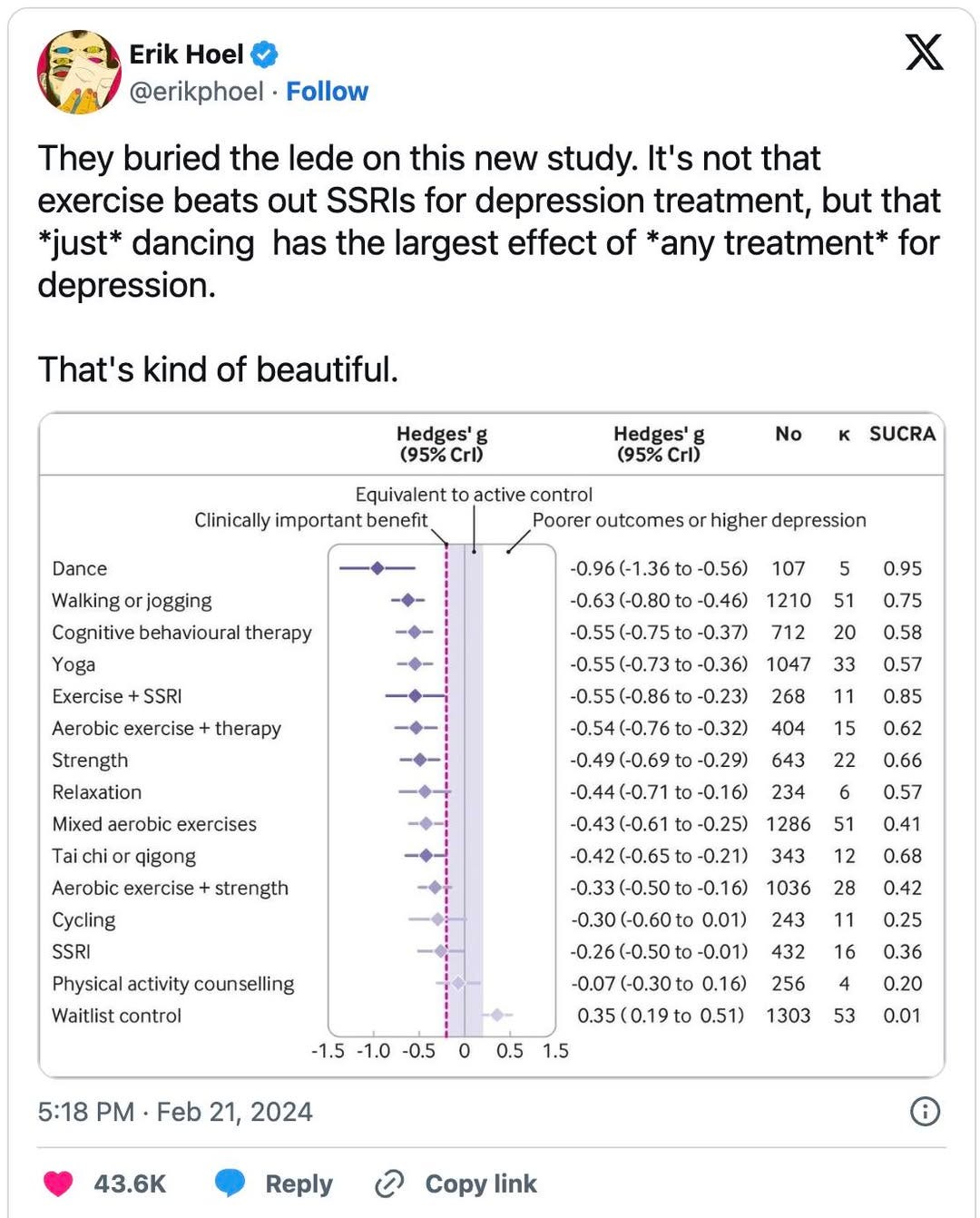
While this particular meta-study has significant limitations, countless people I know will testify: the antidepressant effects of partner dance are real and powerful.
The benefits of dance are well known. It’s great exercise (without feeling like a chore), it increases flexibility, it relieves stress, and it protects against mental decline. But partner dance also fights loneliness, builds relationships, and offers a crucial source of platonic touch. We don’t need more studies to prove that “dance is good for us”—we need more reasons to walk out the door and give it a shot.
3) Dance weekends are a hell of a lot of fun
At the beginning of my dance journey in 2006, my friend Nathen gave me some important advice.
“Taking regular local classes is good,” he told me. “But dance weekends are where you really level up.”
“What’s a dance weekend?” I asked.
“A bunch of people come together to take classes all day and dance all night, for two or three days straight. The people who go tend to be pretty good—they’re the ones who are serious about learning.”
A few years later, I joined my first tango weekend in Portland, Oregon. The dancers were so amazingly good (and the floor so terribly crowded) that I spent most of the evenings just watching from the sidelines, mesmerized and content.
In 2014, I attended a blues weekend in upstate New York. I was a novice, I didn’t know a single person, and everyone was dressed in fancy vintage clothing. Despite feeling that blues wasn’t “my scene,” the classes were excellent, everyone was friendly, and I loved traveling somewhere exclusively for the purpose of dance.
Finally, in 2016, I found a weekend that spoke to me: a fusion dance “Recess” organized by a friend-of-a-friend named Justin Riley. Held at a massive campground in the California High Sierra, Recess was like an adult summer camp. Classes took place through the day, and at night, multiple dance floors emerged among the pine forest, dramatically illuminated by colored lights. Volunteer cooks (including me) prepared three meals a day, and everyone provided their own camping gear. For three days I happily wandered from my tent, to food, to classes, to food, to dancing, to shower, to tent, and repeat.
I felt like I’d discovered a nearly perfect container for combining learning, community, and dance. At Recess, the other dancers were open, playful, serious about learning, yet always willing to laugh at themselves. Skill-building and socializing held equal weight. Dressing up was optional. Various substances were present but never felt necessary for participation (see below: “drinking and drugs, not required”).
Driving away from the campground on my 34th birthday, blasting a new playlist of fusion songs, I felt totally alive. More, more, more! I want more dance weekends!
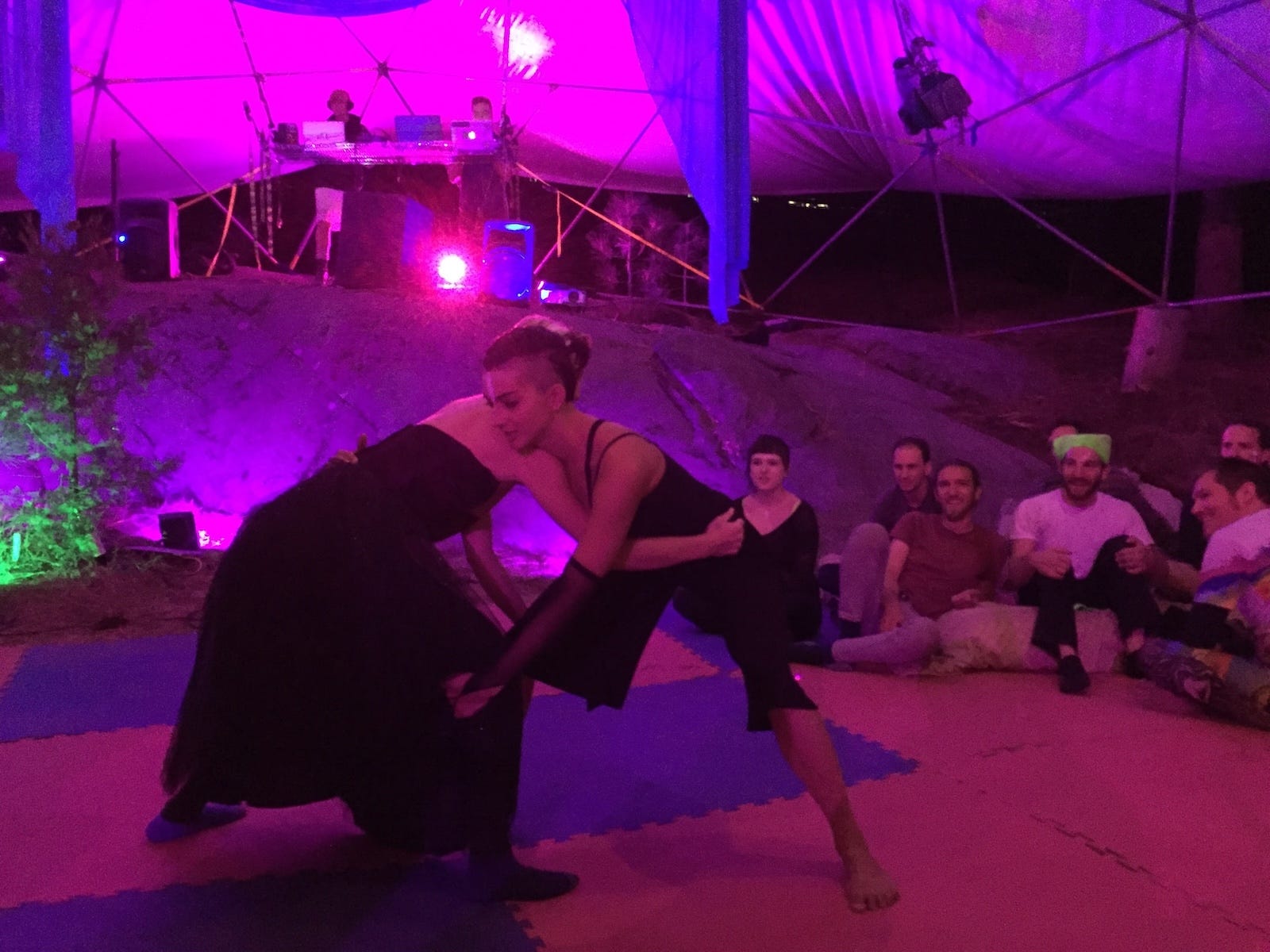
I discovered an entire ecosystem of similar fusion weekends in the US and Europe that brought me to Seattle, Oakland, Denver, Utah, Virginia, Spain, Paris, Berlin, and Washington DC. Then the pandemic happened, weekends were cancelled, and sadness reigned. When they reemerged in late 2021 (in Europe) and 2022 (in the US), I was thirsty: joining roughly 25 events over the last four years—weekends that brought deeper skills, dozens of new friends, and a handful of relationships.
Sometimes I was hosted in foreign cities by dancers I barely knew. Other times I teamed up with others to share affordable accommodation and cook communal meals. I discovered a trusting, inclusive, and high-solidarity community of fellow dance enthusiasts who adored these intense, joyful weekends.
This is all to say: partner dance isn’t just about local classes and local dances. Big, powerful, peak-experience weekends await you, no matter your preferred style—and they’re a hell of a lot of fun.
4) Partner dance teaches communication and body awareness
“Blake, touch my chest!”
The 50-year-old Argentine woman spoke with authority, so I did as she commanded.
I placed my palms on her clavicles. As she walked forward, I held the tension in my arms and walked backwards, matching my steps to hers. When she paused, I paused. When she twisted her torso or shifted weight in her feet, I followed.
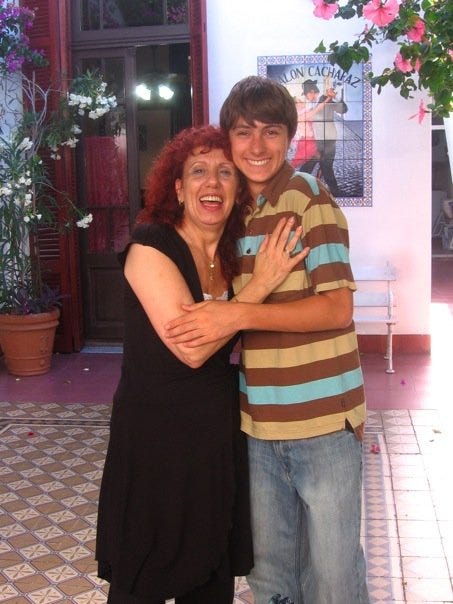
The year was 2008, I was 26, and I was leading my first Unschool Adventures trip to Argentina. Ostensibly, Alicia Pons was teaching my group of teens how to dance tango, using me, for a moment, to demonstrate the art of following. But clearly, something more than tango was happening here.
“As a leader, you need to send clear signals,” Alicia instructed us. “You must know what you want and move decisively. Otherwise, your partner won’t know how to respond.”
For a moment, I felt like I was in a relationship therapy session.
“If you don’t know what you want, then stop moving. Just shift the weight in your feet for a few moments. That’s okay.” Alicia rocked back and forth almost imperceptibly; I felt the motions in her chest and moved my body to match.
Now it was a life coaching session.
“In the early days of Argentine tango,” she continued, “every man had to learn how to follow—to listen very carefully—before he could become a leader, before he could take that responsibility. Today, we have many bad leaders because they’ve never followed before.”
Now: a communication class (and political theory, too).
She released me and entered the middle of the tiny dance studio. “No matter whether you’re leading or following, you must walk confidently. Raise your arms high above your head and take a deep breath. Then keep your chest in that position as you release your arms. Feel your spine lengthen. Feel your new height. This is how you will connect with your partner in tango. Practice walking like this everywhere you go.”
The basics of body language? Alicia just summarized them.
“At a milonga (a social tango dance), it’s common to dance four songs together. If you begin dancing with a partner, you are committing to all four songs. It’s rude to leave early, but you always have the power to say no. If your partner is being disrespectful, walk away immediately.”
Finally, a lesson about consent.
For two weeks in Buenos Aires, Alicia taught my group more than just tango—she taught us how to move with confidence, power, and grace while remaining humble, perceptive, and open to feedback. Having danced, competed, and taught across the world, Alicia had an incredible repertoire of moves to show us, but she focused entirely on one lesson: communication.
What you just read is a chapter from my 2014 book, The Art of Self-Directed Learning—and it’s still my favorite way to illustrate how partner dance offers life lessons that go far beyond the floor.
Partner dance has taught me about clarity, boundaries, connection, creativity, respect, rejection, and responsibility. I’ve learned how to be strong and soft at the same time, how to listen with my entire body, how to make an invitation with only my eyes, and how to enjoy dancing with both total beginners and intimidating professionals. Some of these lessons might have otherwise required years of talk therapy. And it all started with a 50-year-old Argentine woman telling me to touch her chest.
I hope you, too, find your own 50-year-old Argentine.
5) Drinking and drugs, not required
“Don’t you need a few drinks to enjoy dancing?“ “Are all these people high?”
I’m amazed by how many assume that alcohol or drugs must be a part of the social dance equation.
Yes, some partner dance communities do imbibe: more frequently at big weekend events, later in the evenings, and among pre-existing friend circles. But in the communities I frequent, drinking is casual or non-existent, recreational drug use is rare, and most people I know are dancing 100% sober.
This is a crucial difference between partner dancing and more commonplace club dancing. We’re not just bouncing up and down with a drink in our hands, looking for someone to grind on, or trying to enter a trance state. We’re performing a fairly technical act that requires balance, precision, and careful attention to our partner. One glass of wine might help a partner dancer loosen up; three glasses are counterproductive. Dancing with someone who is clearly in an altered state isn’t fun, and it’s potentially dangerous.
We partner dancers are quite good at producing our own chemicals, thank you very much. Supplements are not required.
6) Sexuality and sexism, not required
Two more common assumptions:
pressing your body against someone else’s body is inherently sexual
“lead” and “follow” roles are inherently sexist
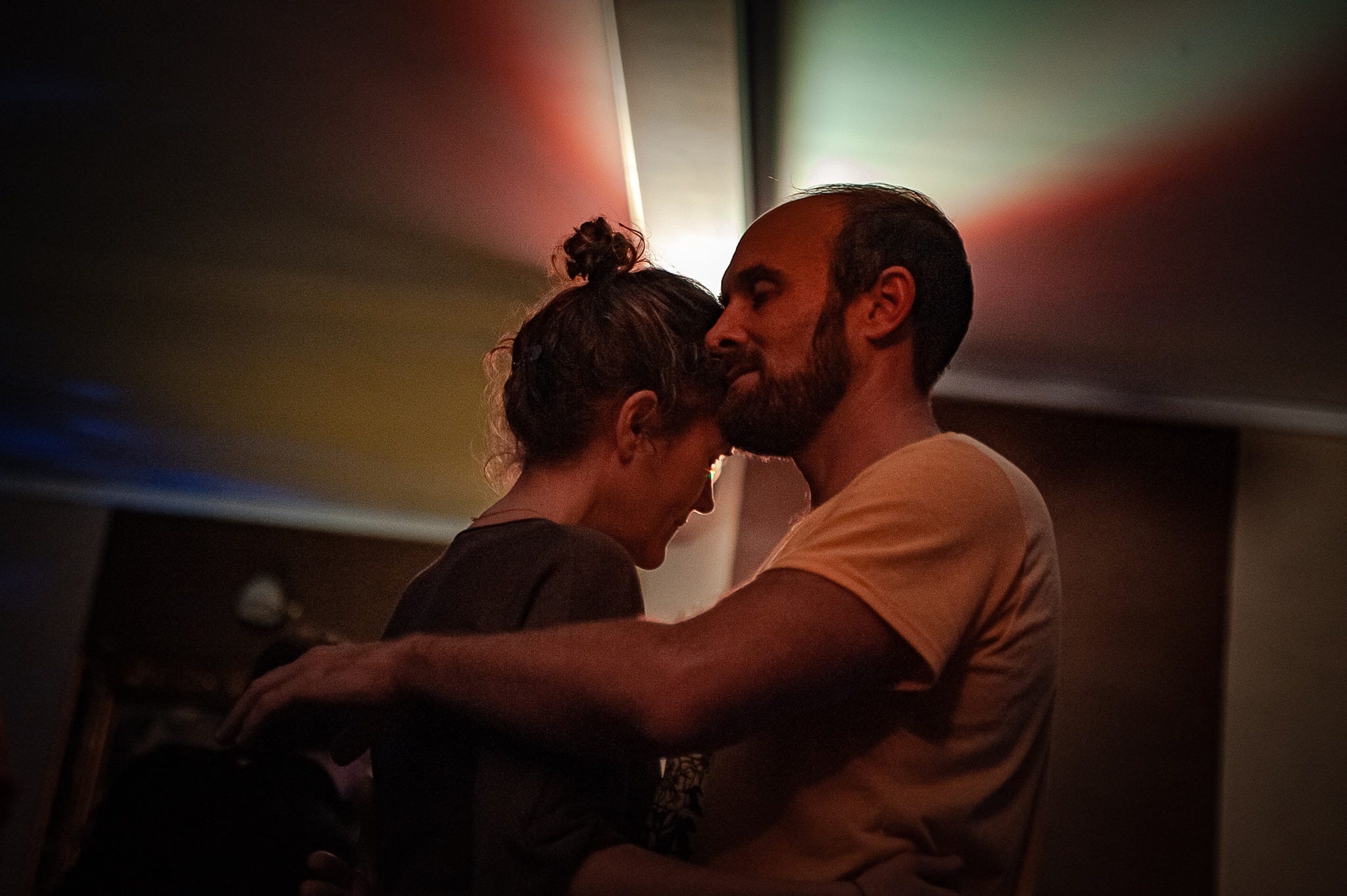
There’s so much to say on this topic, but I’ll emphasize this: partner dance is a fantastic way to receive platonic touch.
In a world where touch is frequently reserved for intimate partners, the simple act of connecting your hands, arms, chest, and belly to another person’s hands, arms, chest, and belly can actually reduce one’s perceived need for sexual contact. You might start partner dancing with a secret hope of romance, only to discover that platonic touch is what you needed most.
This is doubly triply quadruply true for men socialized with the belief (as I was) that you DO NOT TOUCH your friends, family, or anyone but an exclusive romantic partner for an extended period of time, with the exception of team sports and martial arts.
As the dance teacher Gui Prada once mentioned in a class about “close embrace,” which is the most intimate way to hold a partner:
The first time I embraced a man like someone I’m attracted to, my dance transformed.
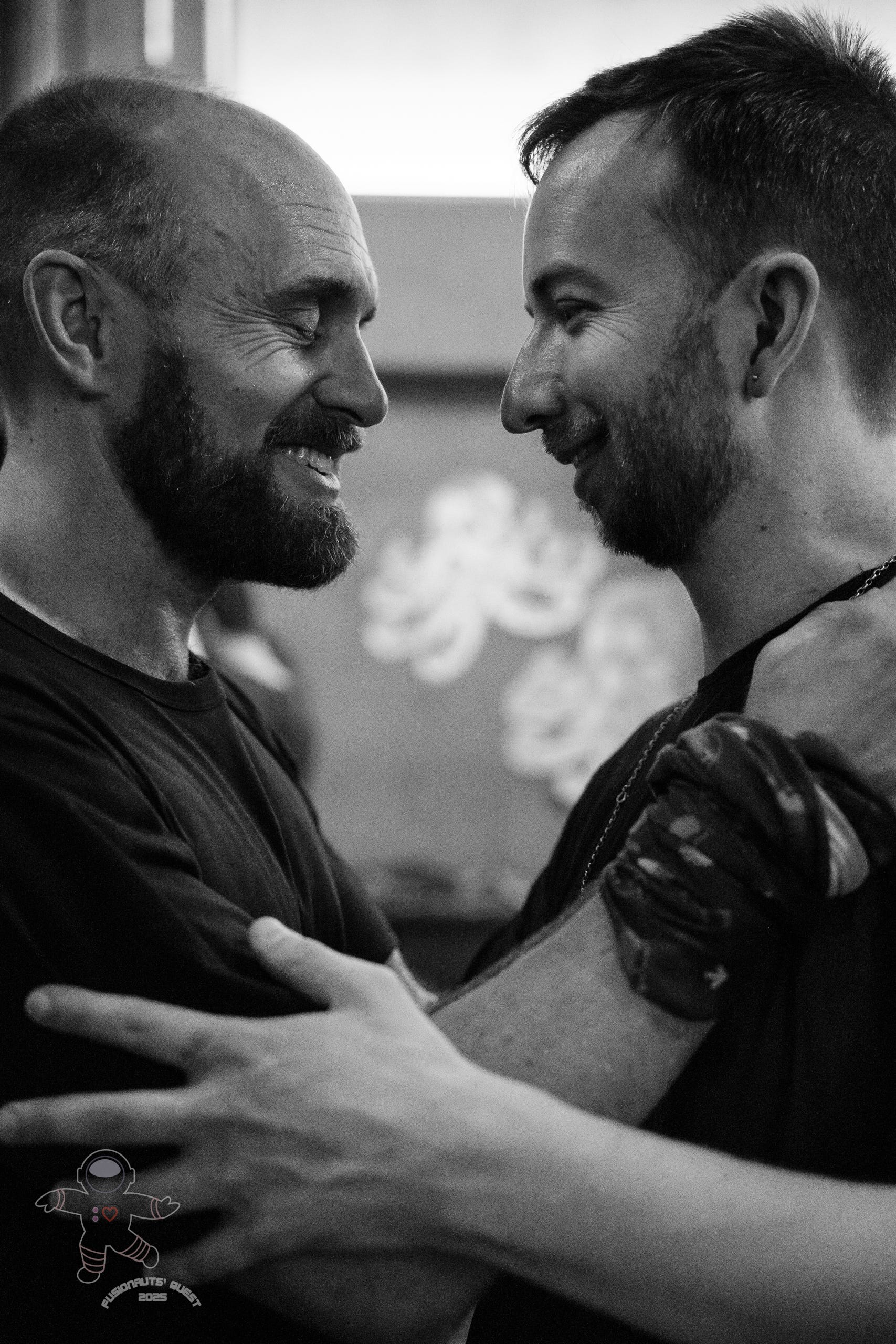
As a straight man, I experienced a similar revelation: dancing with men can be just as fun (or more fun) and nearly as intimate as dancing with women.
Gender-normative Argentine Tango was my gateway into partner dance, which meant that as a man, I was assumed to lead. But I also did much of my initial learning in hyper-progressive Portland, Oregon, where I immediately witnessed many women leading, the occasional male follower, and many dancers of more expansive gender.
But the real awakening came when I entered the fusion dance world, where I learned to ask one, simple, magical question before every dance: Would you like to lead, follow, or switch? Implicit in this question were many beliefs:
Just because someone looks a certain way doesn’t mean they want to dance a certain way.
Just because I’m more comfortable dancing a certain role, doesn’t mean I should never try the other role.
We also have the option of discarding fixed roles altogether and switching between “lead” and “follow” throughout a dance—or even “co-leading” (as practiced in contact improv)
So here’s the good news: partner dance doesn’t have to be sexual or sexist, especially if you’re dancing fusion, contact improv, queer tango, or swing/blues in more progressive communities.
Unfortunately, in many other corners of the partner dance world, sexuality and sexism are very alive. If you want to follow as a man in bachata, good luck finding many dance partners. If you want to lead as a woman in traditional tango, good luck finding many dance partners. If your gender presentation is ambiguous, you’ll have to do a lot more work—and risk weird looks and outright rejection—to find many dance partners. The culture is moving in the right direction, however slowly, while self-described “cazagringas” (slang for “hunters of white women”) continue to prowl the salsa clubs of Guatemala.
Despite the challenges, partner dance can be a place where you go to connect with other nice people, regardless of gender, without sexual overtones or homophobia. Great dances between people who are attracted to each other can be just great dances, and nothing more.
This is the best way to approach partner dance, in my experience: not as sexual conquest, not preening and posturing like a mating bird, but as a way to create profoundly deep, fun, and connective experiences between two people, no matter who they are.
7) Partner dance teaches attention and connection
This is a topic I’m so passionate about, I created a whole workshop to practice it. But allow me to summarize in four bullet points:
the best partner dances begin with giving someone your full, undivided attention, because attention is the most basic form of love
this is vitally important because today, especially with the rise of smartphones, our default mental state is one of continuous partial attention
partner dance allows us to enter a classic flow state of optimal challenge, total concentration, and effortless achievement
partner dance can even feel like meditation—like when dancing “microfusion”: a stationary, eyes-closed dance demanding utter attention to one’s partner and the music
The classic image of a sweaty salsa or swing dancer may not overlap with that of a quasi-meditative state of absolute focus. But it’s real. When you’re partner dancing, you’re not thinking about your phone, you’re not thinking about yourself, and you’re locked into the music and the subtle motions of the flesh-and-blood human in front of you: rare and valuable experiences in a time of constant distraction.
8) Partner dance offers profound meaning
Once you’ve achieved a certain level of security, belonging, and self-esteem in life—once you’ve climbed a good way up Maslow’s Hierarchy of Needs—what’s left to do?
You can start a family and support them unconditionally. You can dedicate yourself to a philanthropic cause, political movement, a business, or your art. You can journey inside, pursuing new truths and spiritual awakenings. You can journey outside, through foreign lands and wildernesses.
You can also… dance.
Dance is the ultimate renewable resource. The number of ways to move your body is limitless, and when you throw in a whole other mind and body—plus a vast, ever-expanding library of world music—the possibilities become exponential. Or as the dance teacher Mark Carpenter described it to me: partner dance is co-created ephemeral art, made in real time with another person, in a room full of other people doing the same.
You will never run out of ways to dance. You can spend a lifetime learning a single style or sample dozens of different ones. You can dance with people who don’t speak your language, all across the world, year after year, or at least as long as your body says, yes—please, god, more, yes!
Dance requires time and money, but no more than most other forms of recreation. It keeps you healthy and limber, connects you to new people, and teaches you timeless lessons. There’s a reason that every human culture dances.
I’ve dedicated lots of my time, money, and energy to partner dance because it’s given me so much. I’m incredibly grateful that it found its way into my life. I hope that you, too, can experience some of its magic.
See you on the dance floor.
❤️ Blake

Thank you to Frankie, Mark, Flouer, Dane, Bronwyn, Martin, Jeremy, Lui, Siân, Tata, Anouk, Tina, Nathalie, David, and Tim for commenting on a draft of this.
[Other things I’ve written about dance: Partner Dance is Magic · Notes from a Master · Saturday Night, Berlin, 3:52am · 30 Nights of Tango · Crème de la Connection]
One sec...Searching for dance classes for my partner and I
Love it Blake! you're the perfect person to do write this post. And thanks for the shout out.