

In lower Portugal, tucked away among the dunes, bluffs, and coves of southwest Europe, lies a lovely little walking path: the Fishermen’s Trail.
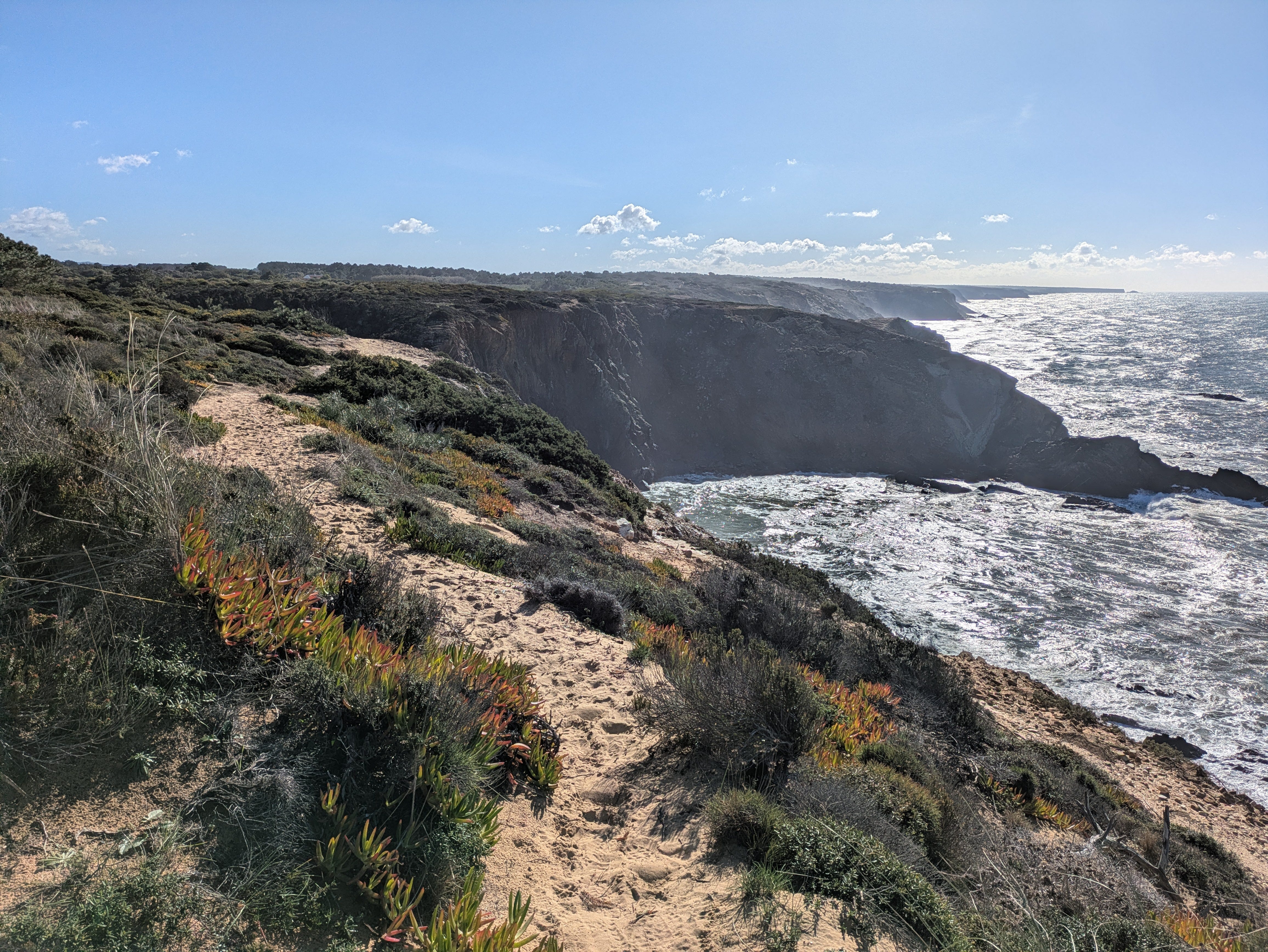
Also known as the Rota Vicentina, the Fishermen’s Trail is a Camino-style route with frequent food, accommodation, and signage. Just pack a few layers, throw a grocery store lunch in your backpack each morning, walk 10-14 miles (15-22 km), find your next bed, scrounge up dinner, and repeat for 12 days.
It’s easy. It’s beautiful. It’s accessible. And you’d be crazy to walk it in mid-summer, when prices are inflated, beds are scarce, and temperatures are sweltering.
Better would be spring and fall—but there are many other great trails to hike then.
So why not hike the Fishermen’s Trail in the dead of winter, when the rest of Europe is a frigid hell, and no other easy hiking opportunities present themselves?
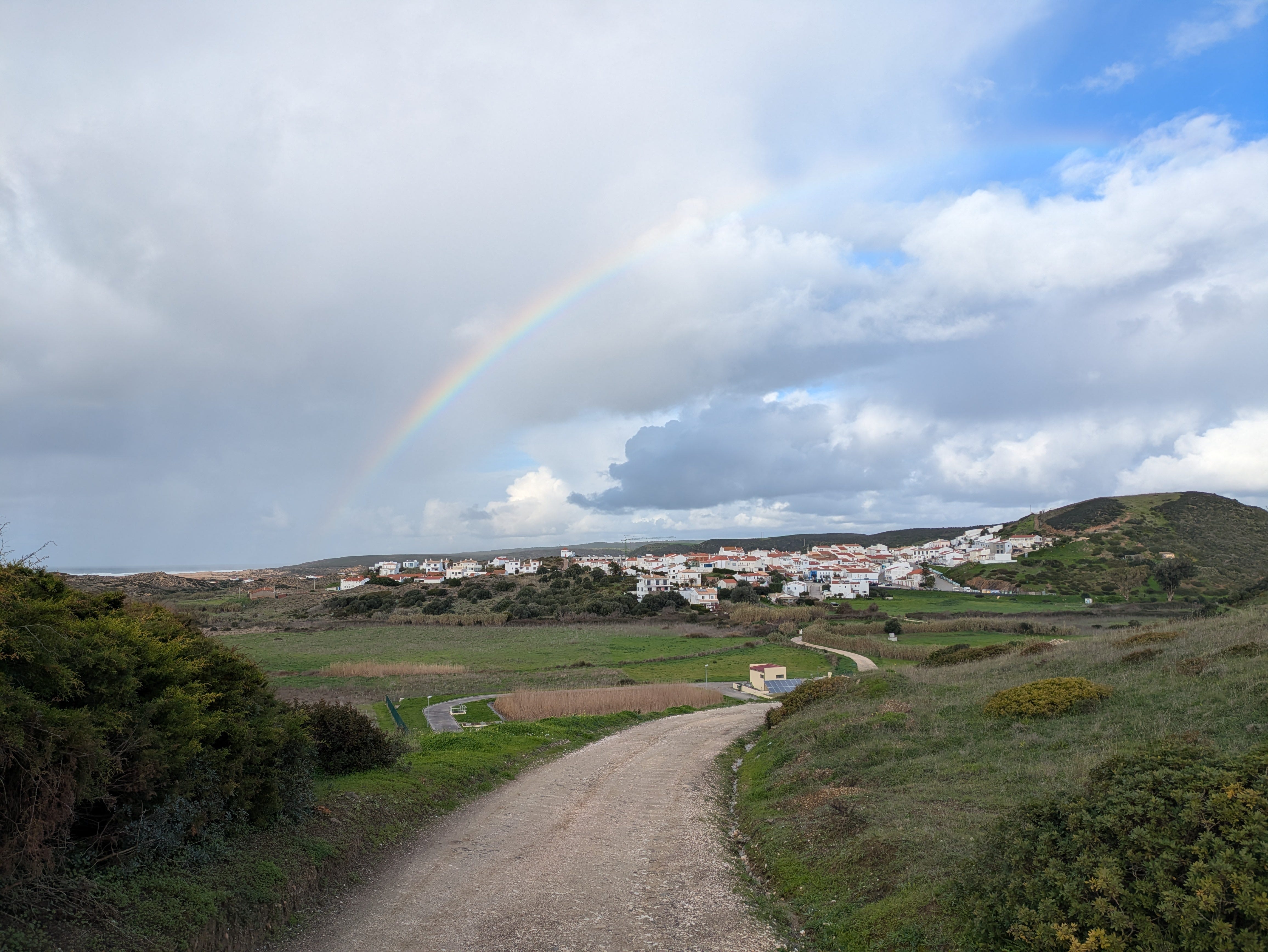
That’s what I asked myself last year, contemplating my next post-New Year mental-health escape. (Previous escapes have included: Spain, Argentina, Chile, Brazil, Colombia, and New Zealand.)
Initial research offered few reports of people hiking the Fishermen’s Trail in January. And many commenters said it was a bad idea due to cold, rain, and the threat of closed amenities.
But further digging revealed that January offered perfectly fine hiking temperatures (for my oft-overheated body), manageable rainfall (less than neighboring months), and no evidence of trail towns closing completely.
Another curious thing: almost everyone seemed to walk the Fishermen’s Trail from north (Porto Covo) to south (Lagos). But I wanted to start in the south (so I could fly into Faro) and end in the north (and visit Lisbon). There was no clear reason to hike southbound beyond the mere fact that everyone else went that way.
That’s how the idea of a northbound, mid-January hike on the Fishermen’s Trail was born. And spoiler alert: we did it, and it was awesome!
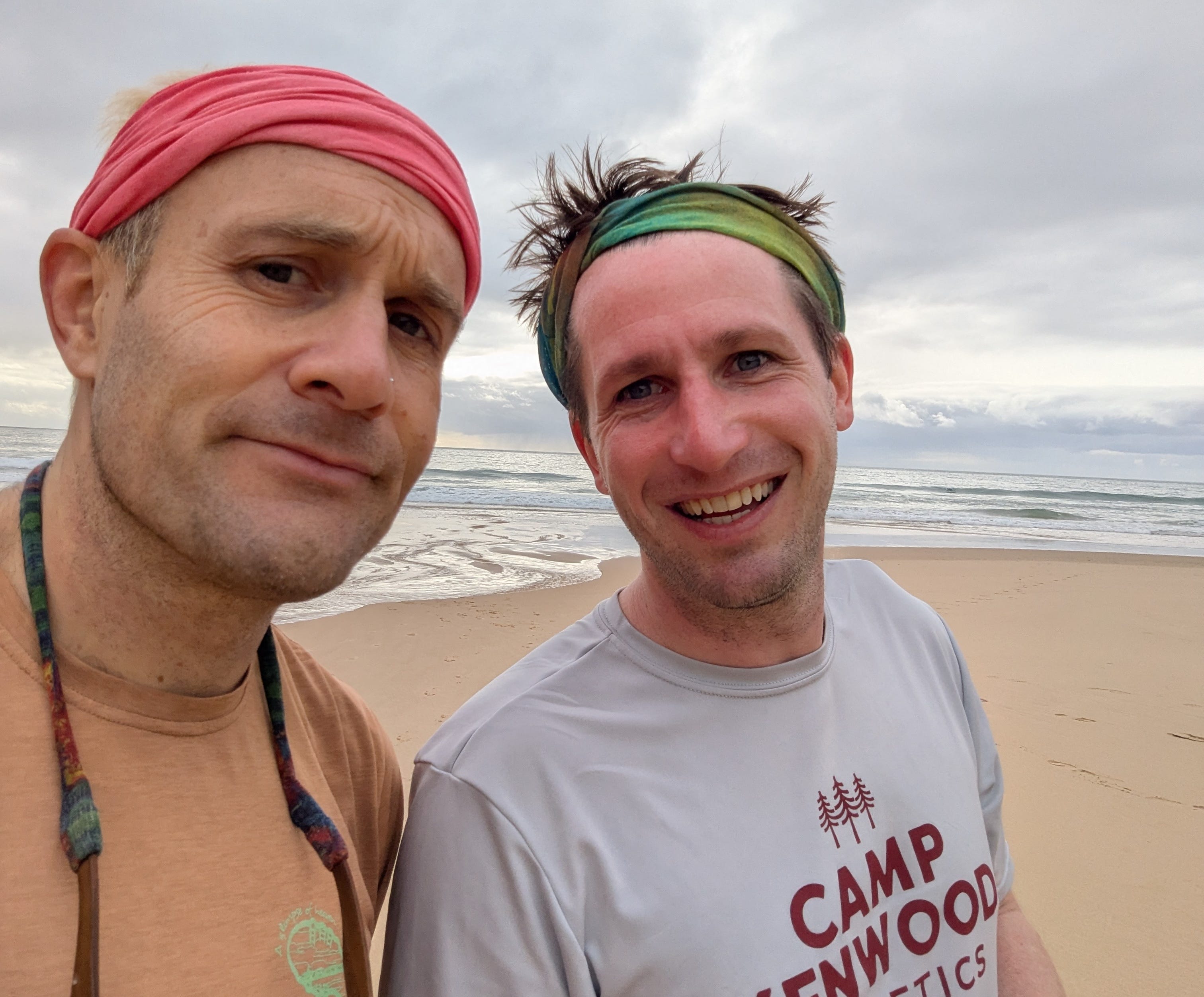
I say “we,” because my friend Jack—the same one who biked the Camino in a shark costume with me—had decided to join the adventure, despite me offering no plan beyond “meet me in Faro and we’ll walk for a few weeks.”
Once again, Jack put his full faith in me, resolving to make the most of whatever might happen on the Portuguese coast.
The world needs more Jacks.
If you’re planning your own Fishermen’s Trail hike and looking for hard facts—distances, finances, practicalities—you’ll find those at the bottom of this post.
But if you’re familiar with my other trip reports, you know that such details don’t get my juices flowing. It’s the human element, the unknowns, and the big questions that matter most.
Why do we—by which I mean, anyone—take adventures like this? What are we looking for? Why do we venture to far-away lands to walk along barren coasts? Why don’t we all just stay home?
These are the questions that interest me, and these are the stories I choose to share.
Enjoy the report, and happy hiking.
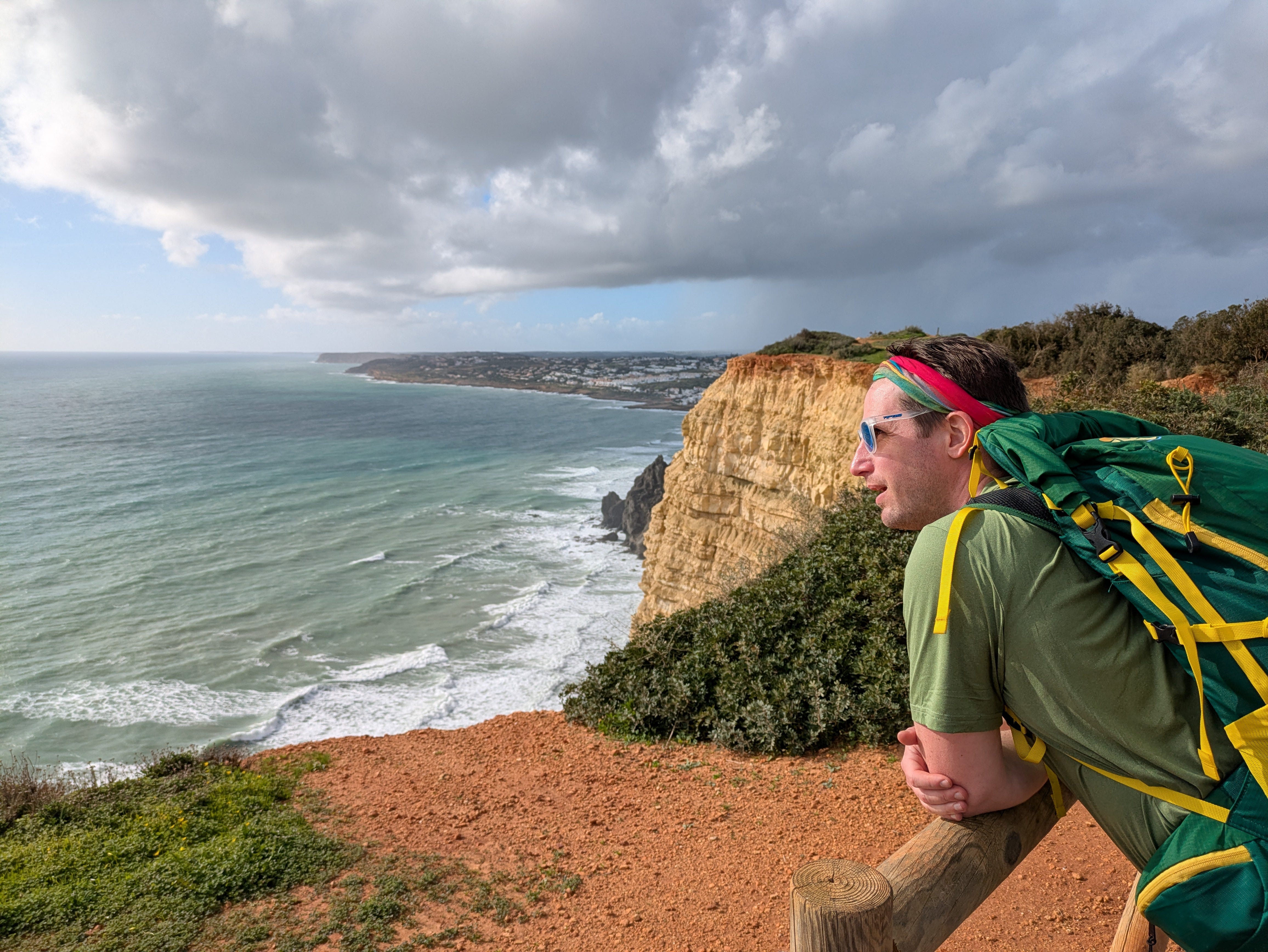
The Fishermen’s Trail Will Not Break Your Heart, But it Will Feed You Unlimited Sushi
When your friend arrives in Faro Airport, it will be essential that you hastily type his last name on your laptop and hold it up as if you are his driver. Because these are the moments that matter: the coming and goings, the reunions and beginnings, and the anticipations of adventures to come.
Trails are but conduits for moments like these.

A bus drops you in Lagos, and you begin walking.
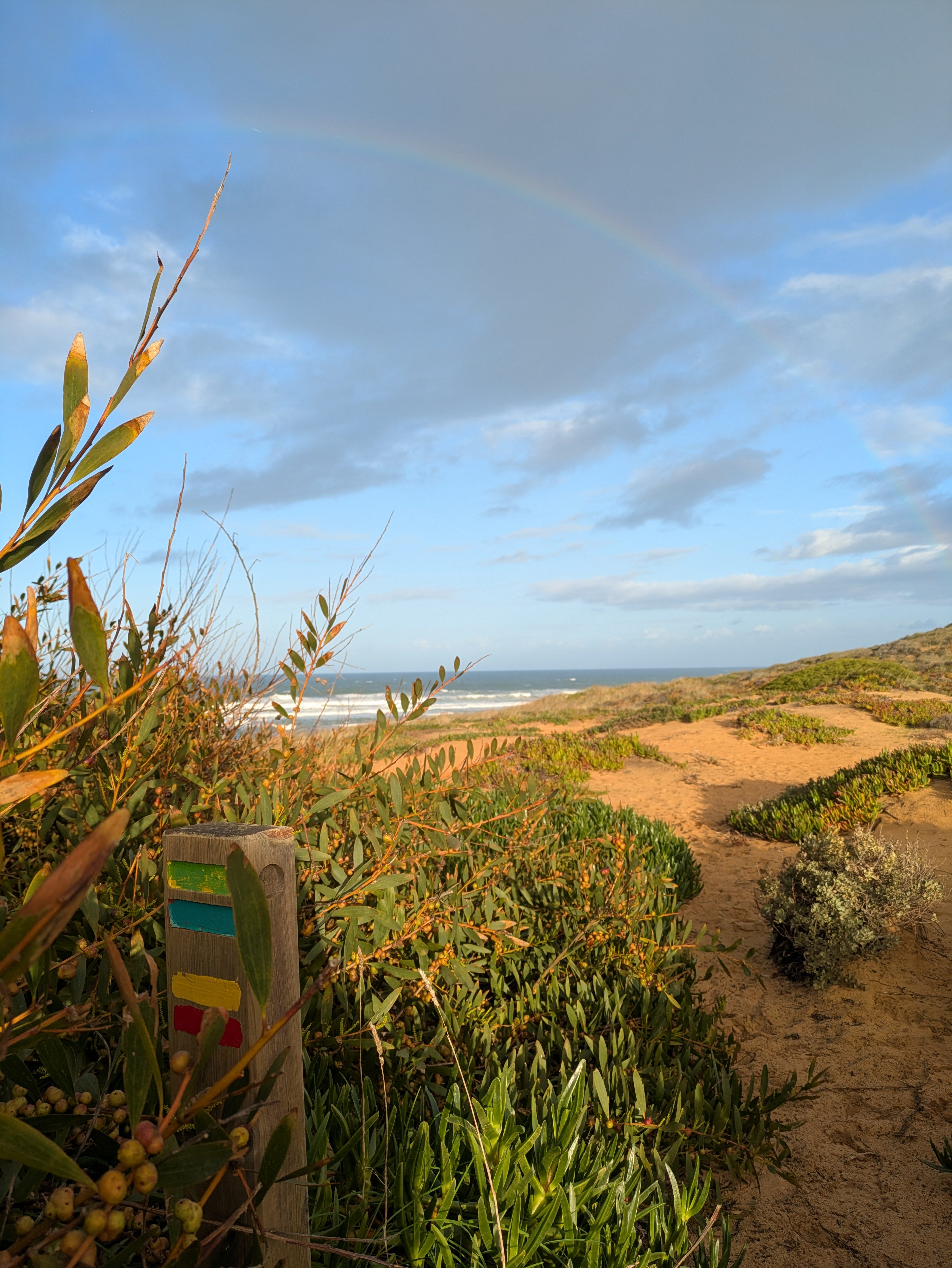
The Fishermen’s Trail is well-signed. Like the little yellow arrows of the Camino de Santiago, the Fishermen’s trail is marked by pairs of little green and blue lines, painted on buildings, light poles, utility boxes, the back of stop signs, and an endless army of small wooden posts.
Almost immediately, you lose your way. But you don’t want to be checking your phone all the time to make sure you’re on the absolute, official route. This is a simple trail, and you develop a simple rule: keep the ocean on your left, horses on the right, and you’ll eventually find your way.
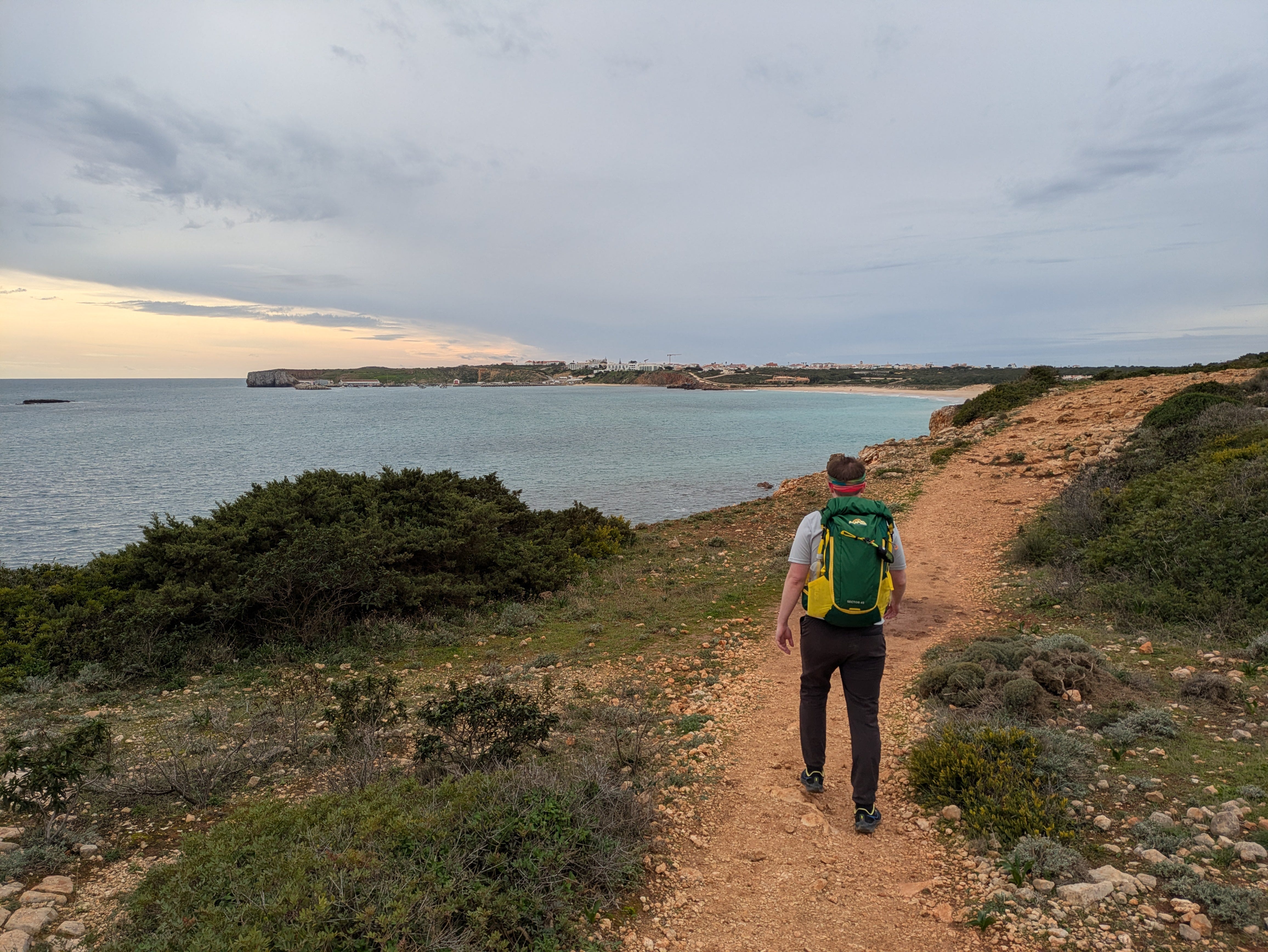
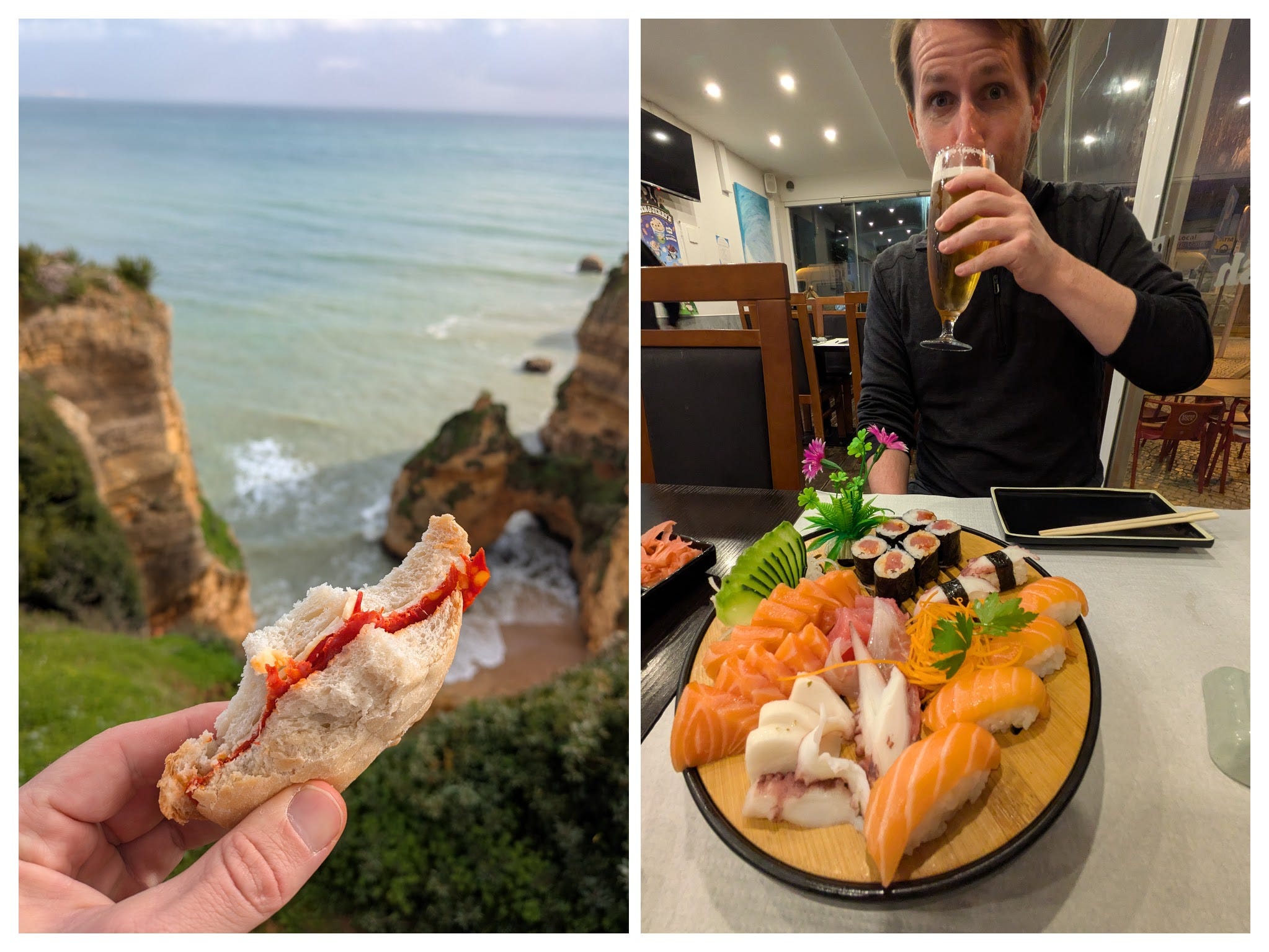
You buy bread, meat, cheese, apples, chips, and cookies from a mini-market and smash your first lunch overlooking dramatic cliffs. This is your life now—eating little sandwiches, with amazing backdrops, in t-shirt weather, in the middle of January—for a little while, at least.
In the second trail town, Salema, you stumble upon a sushi restaurant: well-reviewed, with honest-to-god, all-you-can-eat including sashimi for 17 euros ($20). Eventually, you’ll notice that half of the towns along the Fishermen’s trail have similar joints, all similarly priced. Apparently it’s a thing here. But this little spot, with its overflowing octopus and hyper-attentive servers, sticks with you. You don’t forget your first time.
As you settle into a hiking rhythm, your mind relaxes, and you begin to philosophize, often inappropriately: What is an “ocean” but one, big, all-you-can-eat sashimi restaurant?
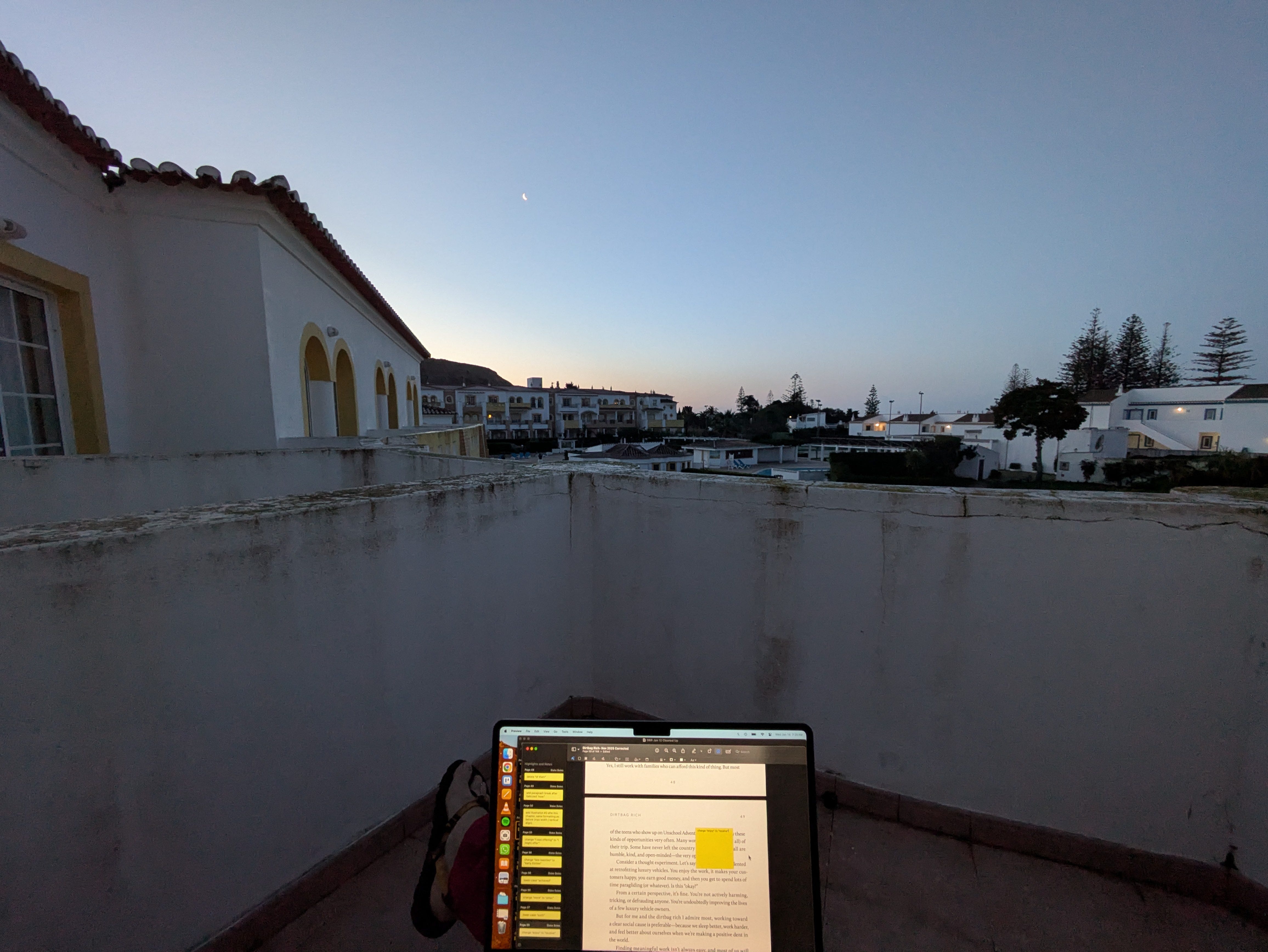
But listen, life here isn’t just endless picturesque coasts and overflowing buffets—we’re working, too! Which is totally possible on the Fishermen’s Trail, since a typical day requires just 4 or 5 hours of walking.
The days are short, but longer than other parts of Europe: first light is 7:30am, and sunset is 5:30pm. Mornings and evenings are chilly (we’ll each wear multiple layers), but you’re not crazy to wear shorts and sandals. It’s a forgiving, California-style winter.
On a typical day we begin hiking around 9 or 10am. We arrive around 2-3pm. We drop our stuff, shower, and have plenty of time for emails, calls, writing, and whatever else our dirtbag rich lifestyles require of us. (Jack, who recently purchased a summer camp, considers himself “debt-bag rich” at the moment.)
Finally, before knocking off around 9pm, we book the next evening’s beds. Even though some accommodations close in January, there’s plenty of space, and pre-booking isn’t necessary. The flexibility is delicious.
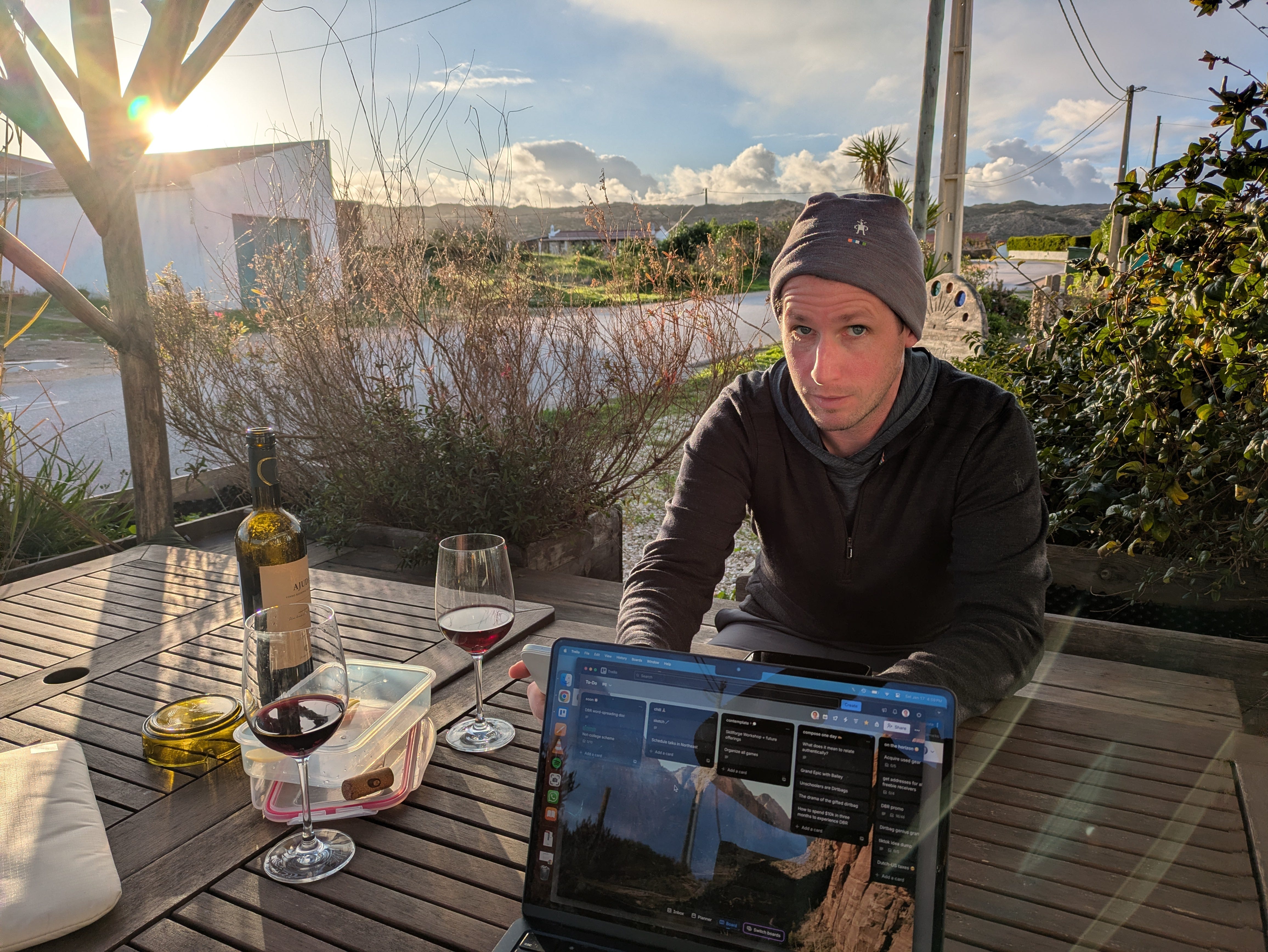
Jack introduces you to a new term, friction-maxxing: deliberately adding friction to a life of comfort and building up tolerance for so-called “inconvenience.”
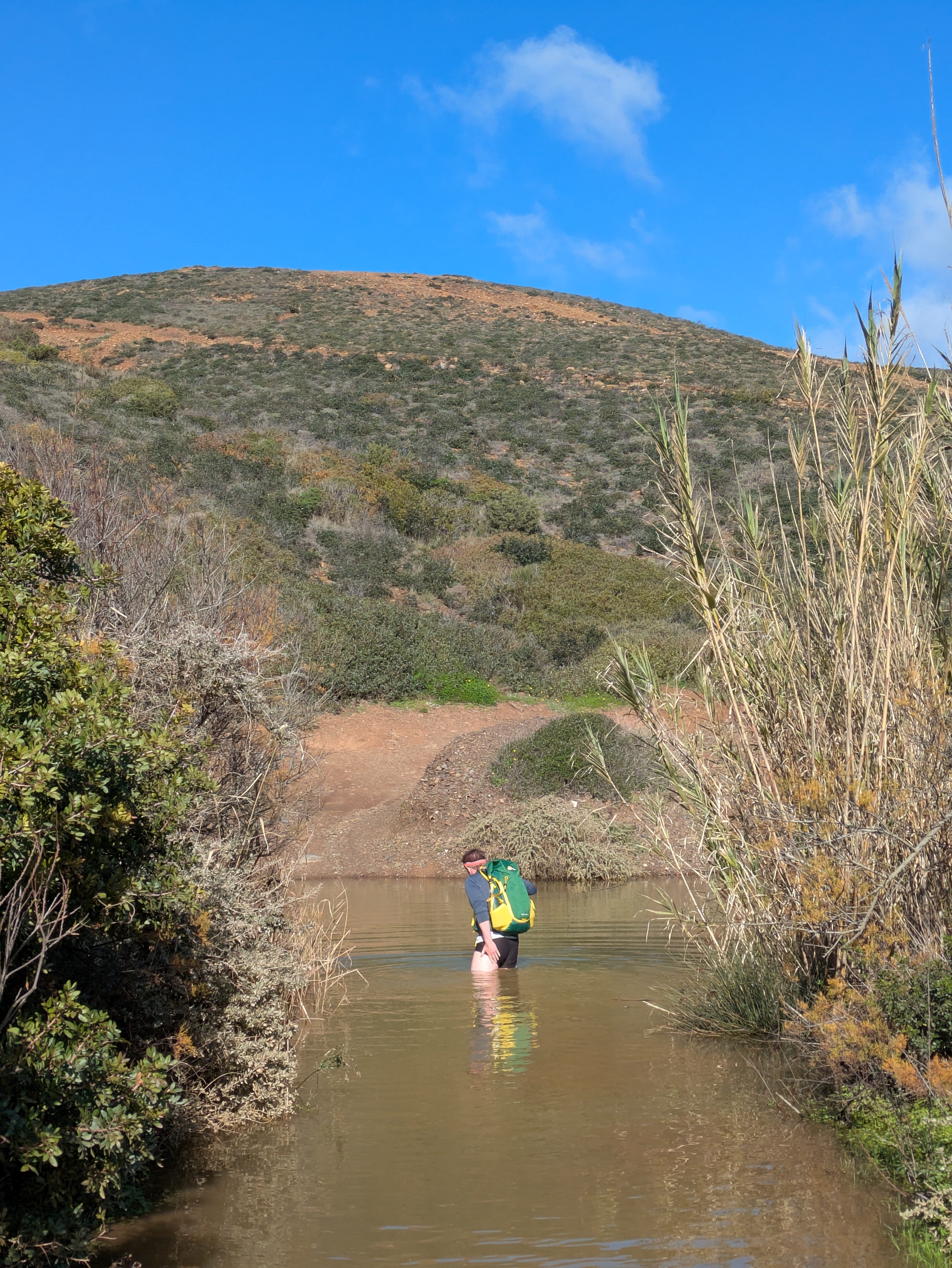
The Fishermen’s Trail is, in fact, an easy trail. One could quickly adjust to its comforts and conveniences. So we begin to embrace the dead-ends and brief disorientations, the trail-swallowing puddles born of recent squalls, and the barbed-wire fences that occasionally stand between us and our next beds.
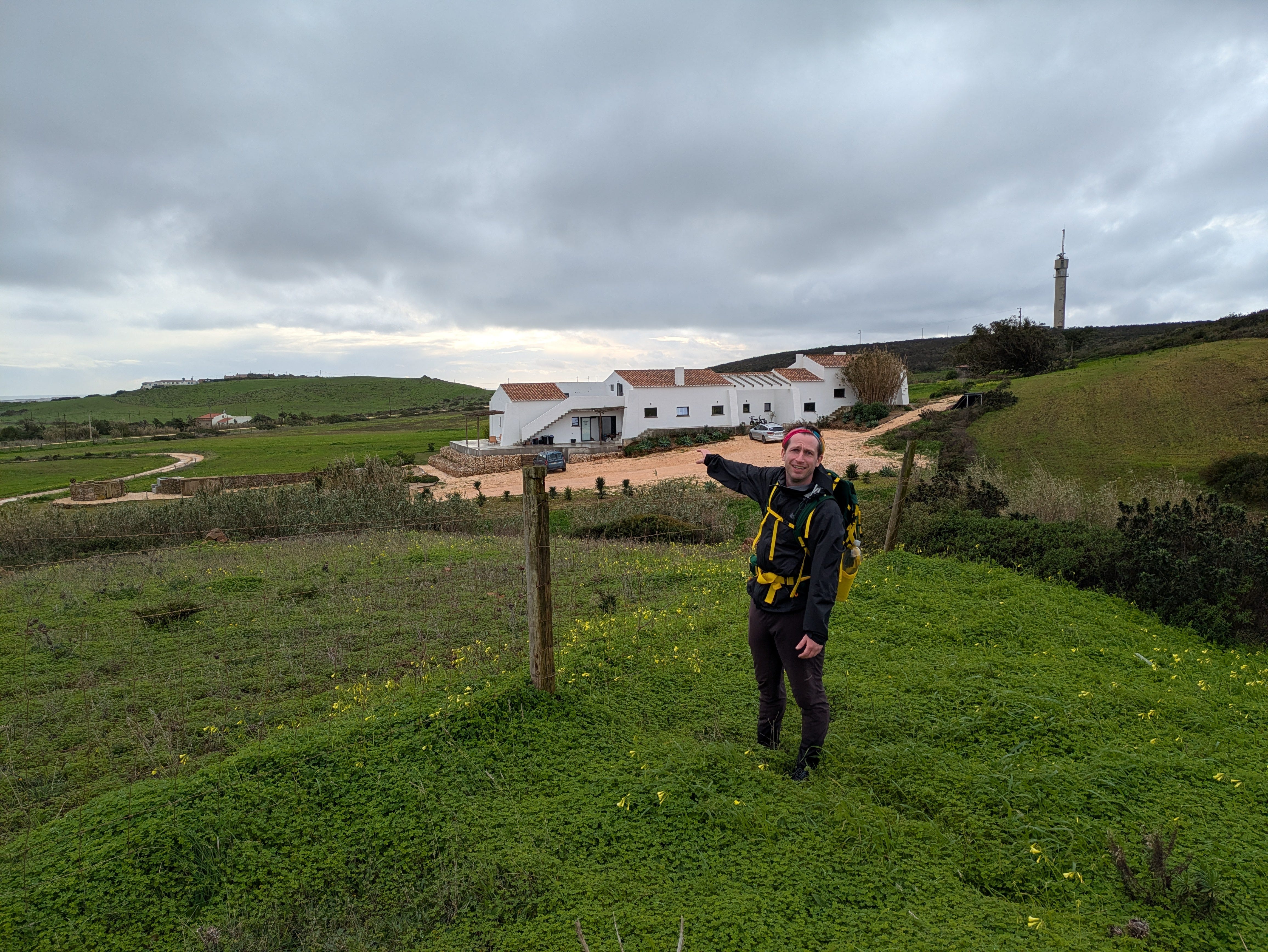
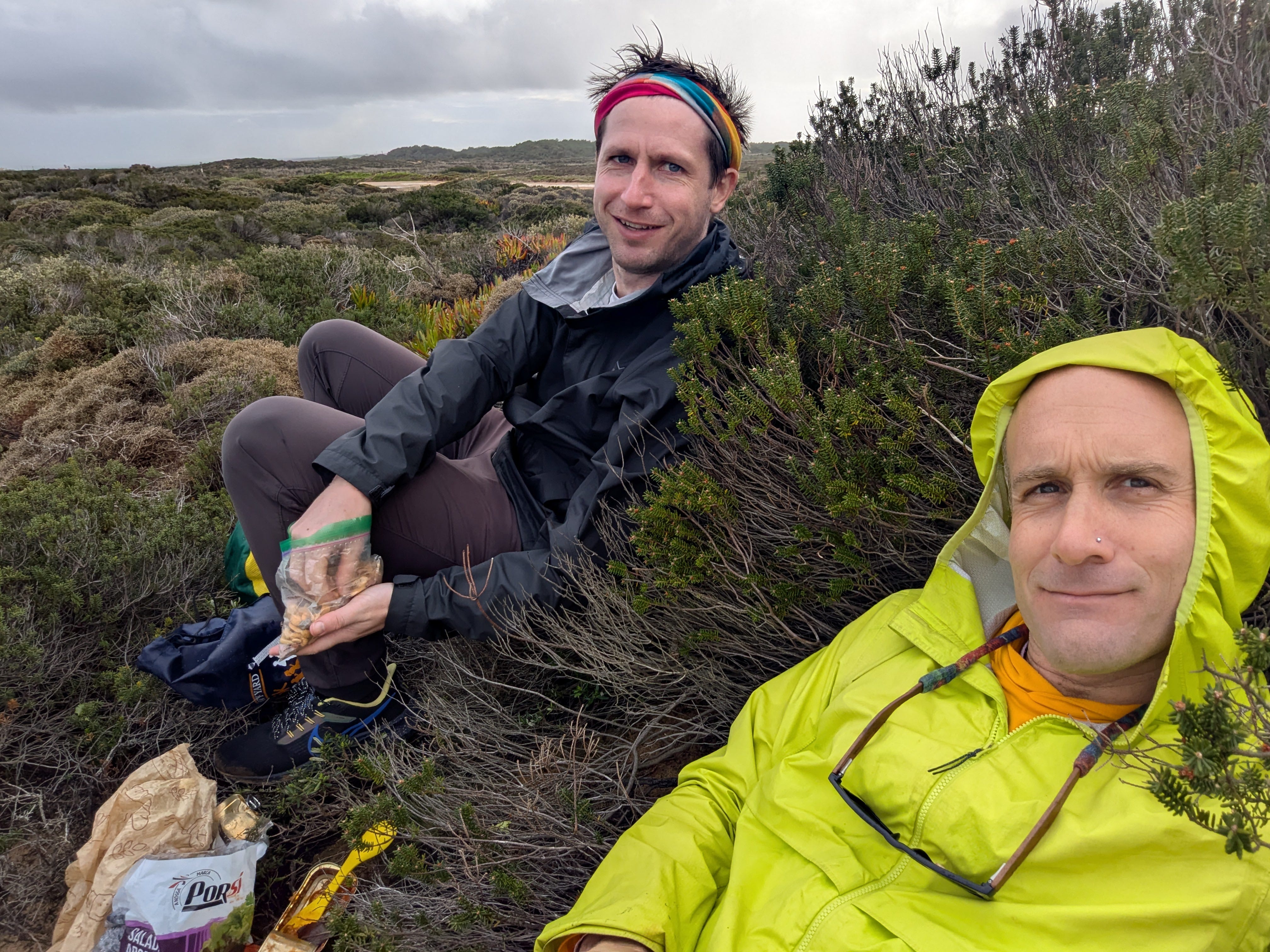
One day, we munch on sardines and greens on ciabatta while hiding from the wind behind tall bushes. Then the rain begins, drives us back to the trail, and for a full half hour, soaks the westward half our bodies.
Rain and wind can, and will, conspire against you on the Fishermen’s Trail in January. But forecasts are generally accurate, if you’re willing to wait out the worst of it—and perhaps skipping an entire day to let a storm pass—you’ll be fine. Over 12 days, we hiked in less than 60 minutes of rain.
Sand-walking was another worry, but ultimately not a problem. The deepest dunes were limited to our final day (i.e., most hikers’ first day), from Milfontes to Porto Covo. If you hate walking in deep sand—as I do—just skip that day. Otherwise you’ll enjoy mostly firm surfaces with short stretches of sand, plus a handful of steep, slippery scrambles.
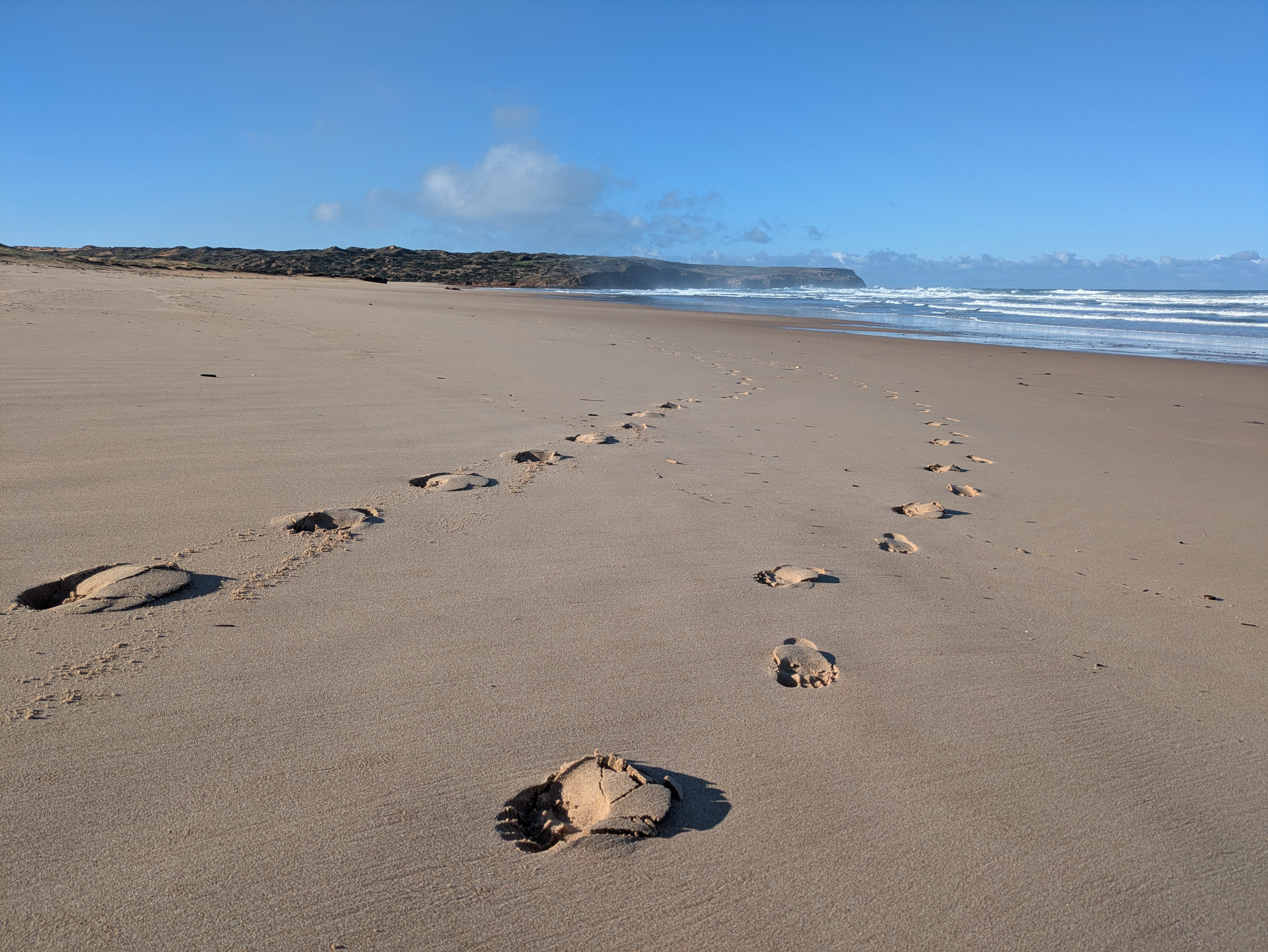
But you will forget the sand, wind, rain, and puddles, for they are but bumps on the parchment on your adventure. What you will actually remember, what you will etch with ink into the ridges and folds of your gray matter, are the names, faces, and fleeting moments shared with those people you meet along the way:
the grocery store cashier from Buenos Aires who exchanges a few grinning words of Argentine slang with you
the Dutch hiker who joins you for dinner in the ghost-town sushi restaurant, working toward a medical degree with a Master’s in ethics, who argues for compassionate euthanasia as a fundamental right
the sour-faced woman who lets us fill water bottles in the utility sink of her closed restaurant
the steak guy who preaches the gospel of ribeye and shakes our hands on the way out the door
the two enthusiastic young British hikers whom we advise to turn around one afternoon—rather than continuing 4 more hours through dicey dunes and swollen rivers—whose hands we shake (inspired by steak guy) when they ultimately decide to turn around
hard-charging, forever-smiling Adam from Slovakia, who is “definitely not high” but just has trouble understanding English, for which he compensates by smiling
and dear C
éline, a reader of this very newsletter, who kindly offers to host and feed us for a night, who laughs with us about the obscure French phrase “courage, mon ami” and smiles as we coach her 14-year-old, always-unschooled son on his upcoming, first-ever, multiple-choice exams
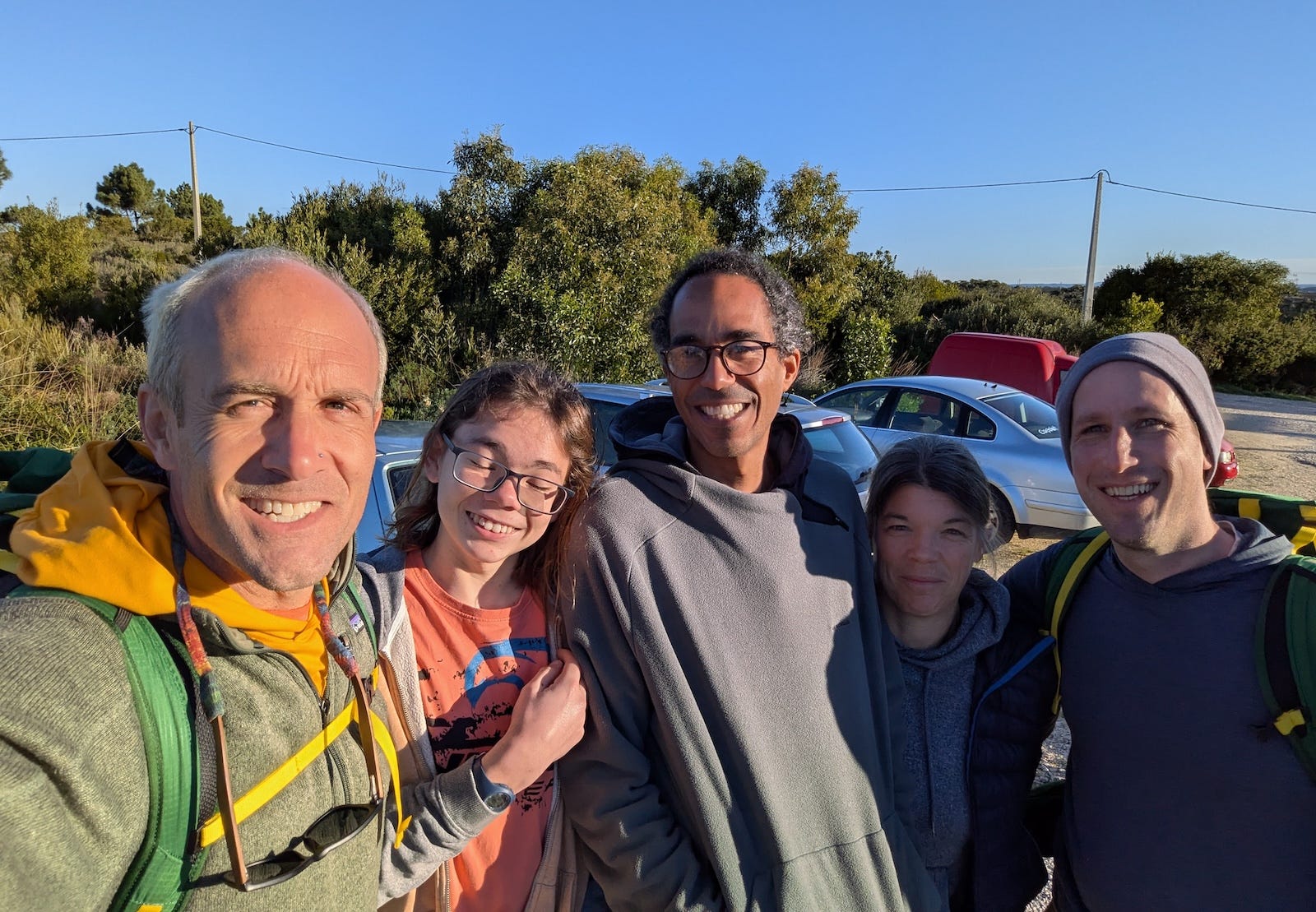
These are the moments that you can easily share with others. But there are also moments of quiet transcendence, dawning awareness, and subtle realization:
watching a troop of sun-drenched toddlers run around a lawn, dragging large sticks and screaming joyfully, just after storm clouds part
listening to Jack describe his experience of depression at the Cabo de São Vicente lighthouse, perched on a stone step, peeling mandarins together
walking away from Odeceixe with no food (because nothing opens until 10am) to find a delightful roadside cafe, where three pastries, two coffees, and two chorizo pockets cost a total of €6
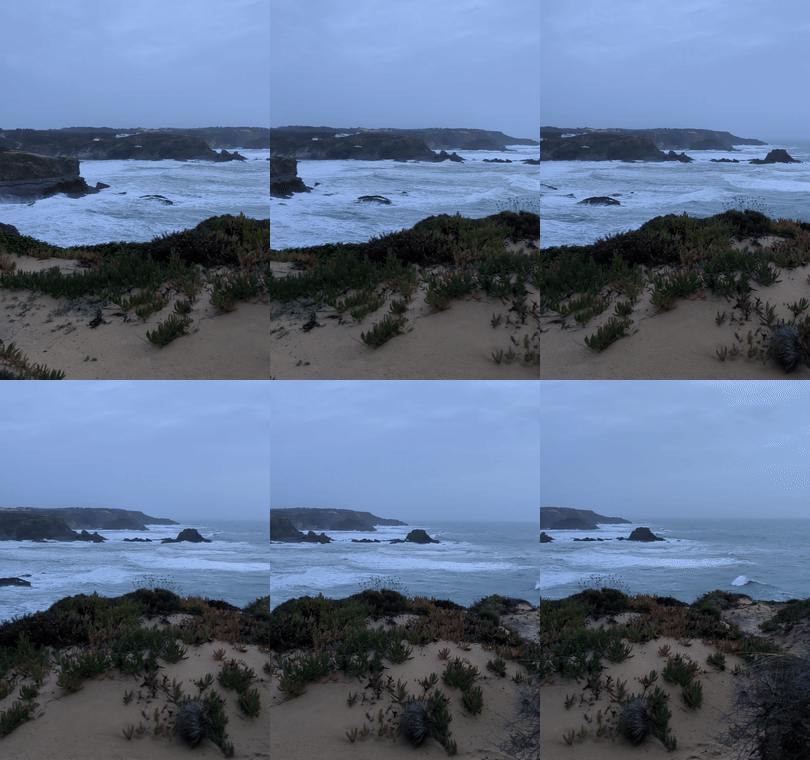
waking to the brutal roar of the western ocean at 6am, unsure if it is the Atlantic or Pacific
reading Desolation Angels with um pouco de vinho tinto, perched on a sandy bluff as waves crash below, as day fades to night
What else do your hastily scrawled notes and internal memory banks tell you?
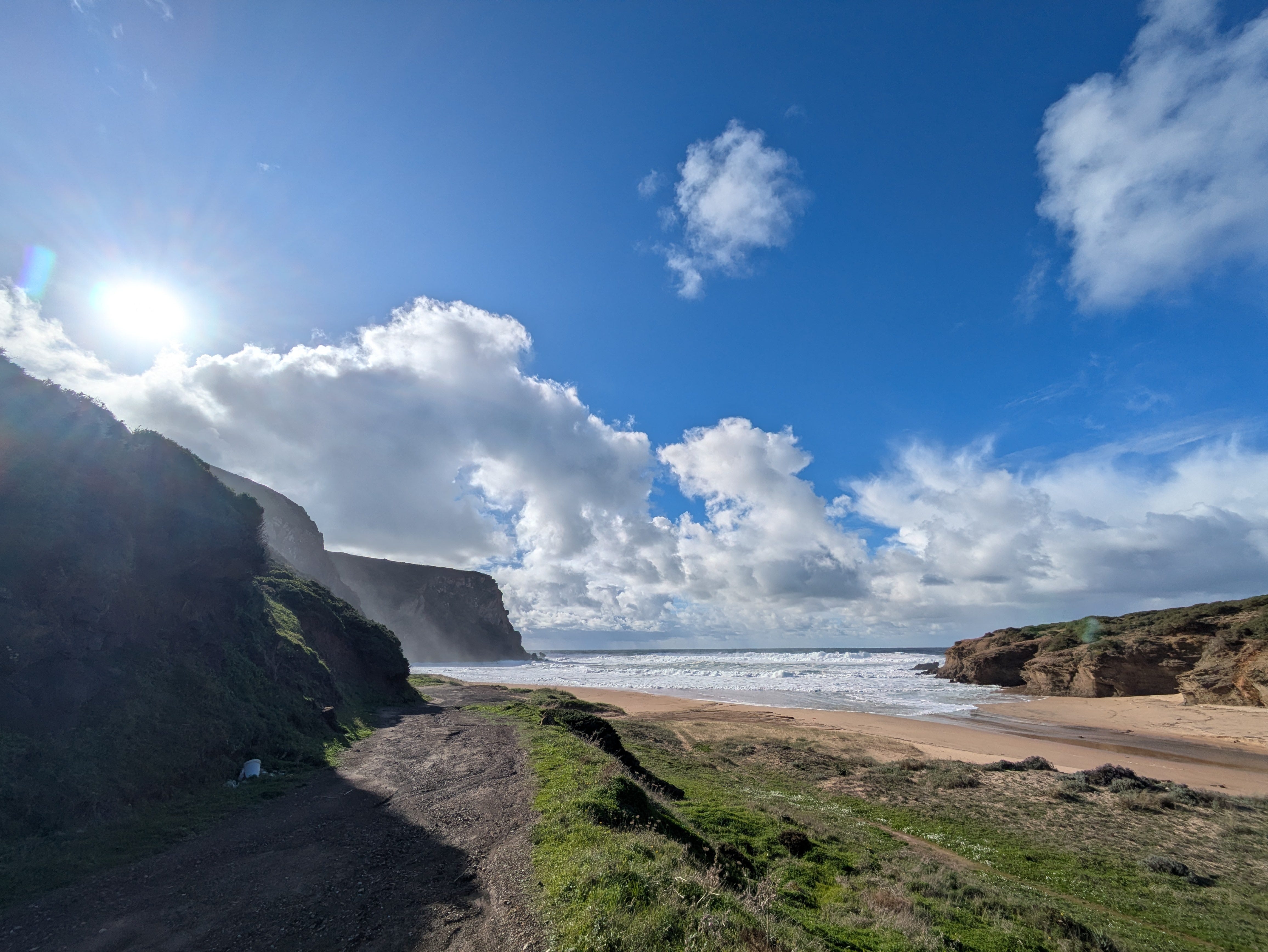
What about sprinting 15km to avoid a forecasted rainstorm, and instead being rewarded with pure sunny bliss?
What about the mysterious potatoes you find embedded on the trail, evidently washed downhill from a nearby farm?
What about the next program for young adults that you scheme, with Jack as your muse—the one that might tie together everything you’ve been working on?
Or finally discovering something that you and Jack disagree about: the nefariousness of advertising?
And what is transcendence, if not a large pig walking down the trail toward you, wagging its tail like a dog, accompanied by one mule, three horses, and zero humans?
In the end, you are still you. You adore sun and movement. You love sweeping vistas, endless horizons, and language barriers. You still read books, write postcards, and get temporarily lost in pine forests.
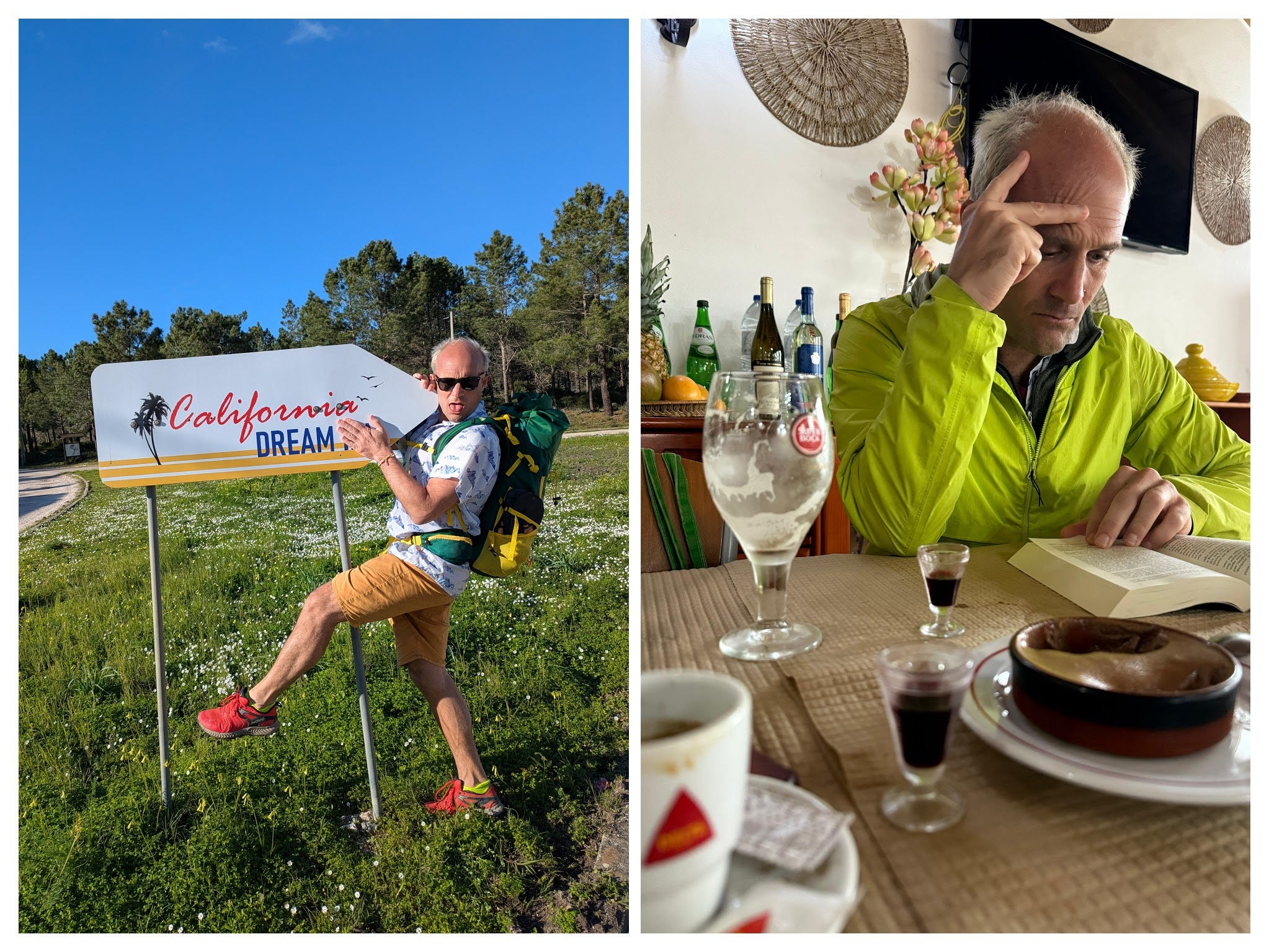
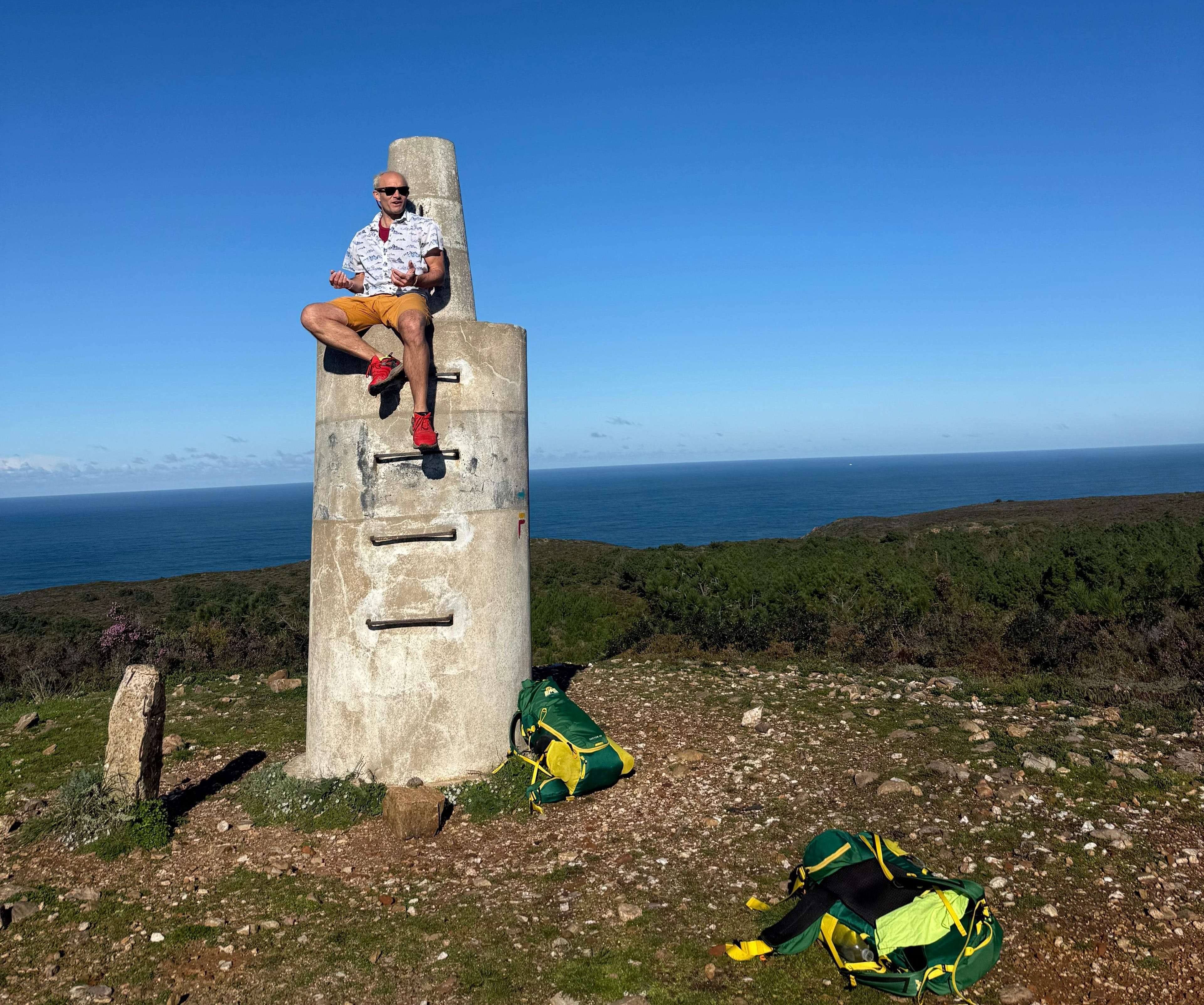
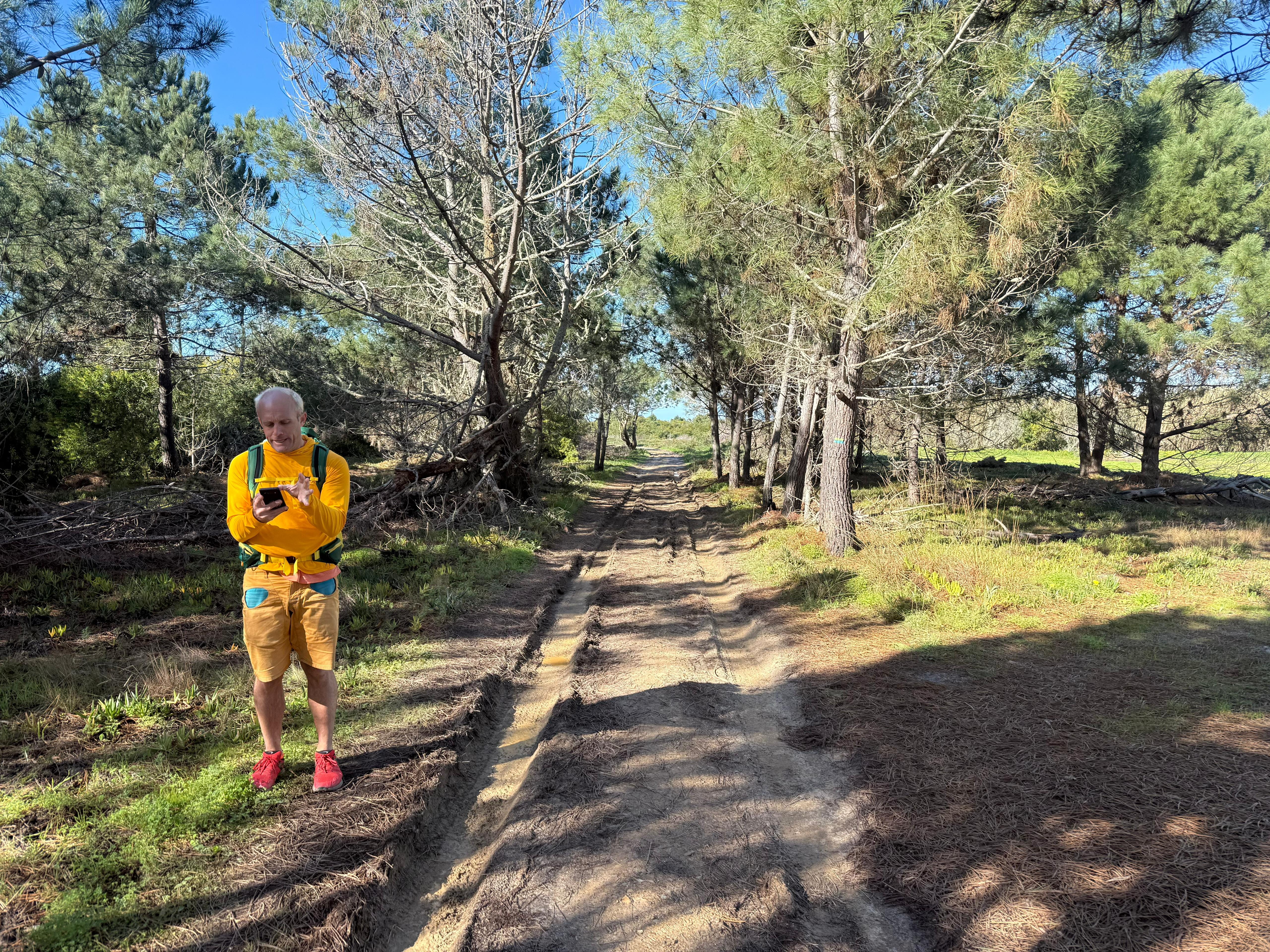
You still wonder why so many people inhabit gray, rainy, concrete cities when they might equally inhabit clear-skied, somewhat-less-rainy, foreign coasts: walking, smiling, inappropriately philosophizing, and seeking those ever-elusive pockets of somewhat-firmer sand.
You still check your phone impulsively, addicted to the intermittent reinforcement of email and Whatsapp notifications.
You still catch yourself posting TikToks (one / two / three) atop picturesque cliffsides. (More accurately, Jack catches you.)
You are still part of the very problems that you rail against.
It’s reassuring to know that, here in coastal Portugal, on your friction-maxxed, sushi-filled, cliffside journey, you are the same person as before.
Except you’re not. How could you be? Because it’s only through moments like these that you ever ebb and evolve. It’s subtle, but it’s happening—right here, right now—as reliably as waves lap the Portuguese coast.
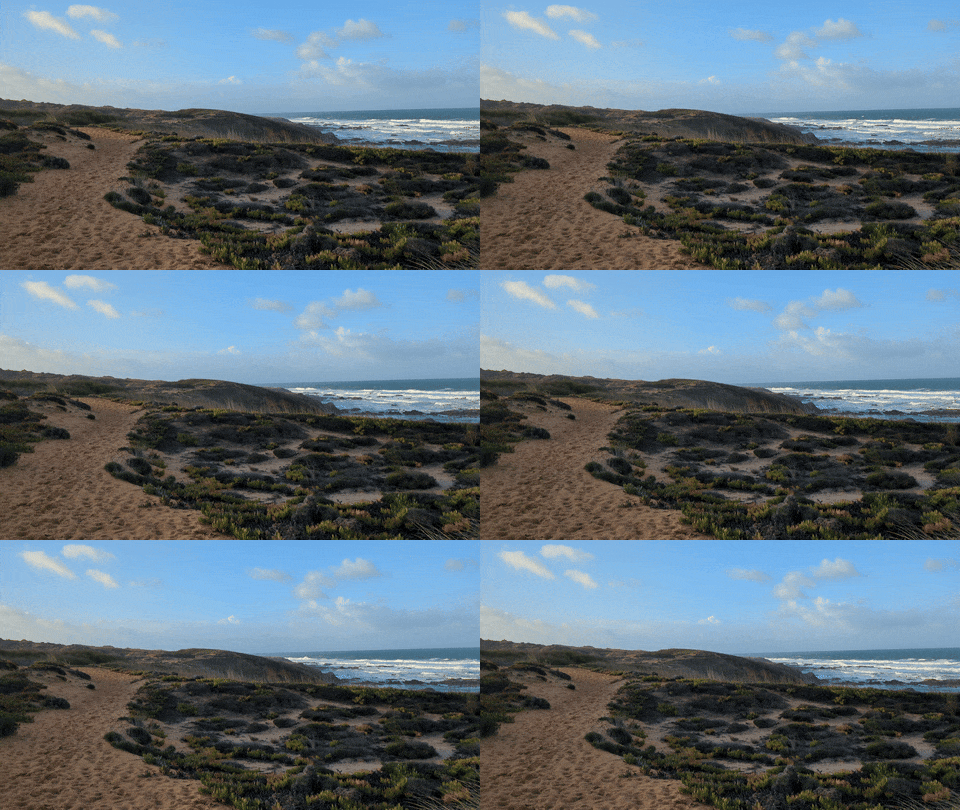
“The true risks of travel,” writes Kate Harris, “are disappointment and transformation: the fear you’ll be the same person when you go home, and the fear you won’t.”
Will the Fishermen’s Trail transform you? Will it disappoint you? Will it fill you up with hot espresso and delicious pastries at exceedingly reasonable prices?

There’s only one way to find out.
Happy trails,
♥️ Blake
The Hard Facts
Stages, distances, and accommodation
We mostly followed the traditional stages and routing of the Fishermen’s Trail, referring frequently to the Stingy Nomads guide for elevation change, trail conditions, and other context.
All of our accommodations were private twin rooms with bathrooms (prices indicated are for 2 people).
Lagos Bus Station to Luz (12km) - Club House CVL €26
Luz to Salema (12km) - Salema Eco Camp €45
Salema to Sagres (20km) - Sagres Sun Stay €48
Sagres to (down the road from) Vila do Bispo (18km) - Casa Nook Sagres €95*
(near) Vila do Bispo to Carrapateira (18km) - Casa Presente €61
Carrapateira to (just beyond) Arrifana (23km)** - (stayed with friends)
Aljezur to Odeceixe (26km)*** - Residencia do Parque €44
Odeceixe to Zambujeira do Mar**** (19km) - Breathe In €58
Zambujeira do Mar to Almograve (23km) - HI Almograve €55
Almograve to Vila Nova de Milfontes (16km) - MUTE Hostel €52
Vila Nova de Milfontes to Porto Covo (20km) - MUTE Hostel €44
*This was actually a whole studio apartment! Fancy pants.
**We followed the coastal route, not the inland route indicated by Stingy Nomads.
***Since we stayed with our friends in Arrifana, we skipped the entire Arrifana-Aljezur section (it would have been just a 7km day or a lot of backtracking). We got a ride to Aljezur and added some extra coastal walking (i.e., we got lost).
****We took a rest day in Zambujeira do Mar to avoid a rainstorm.
Costs
On average, Jack and I each spent €26/night ($31/night) for lodging, and roughly the same on food (none of which we cooked ourselves).
The bus from Faro Airport to Lagos, and Porto Covo to Lisbon, each costs under €10 (Flixbus/Rede Expressos). The only other things we spent money on were laundry and drinks (not much).
Doing it like we did, you can hike the Fishermen’s Trail in January for USD $900-1000.
A few reasons to walk north on the Fishermen’s Trail
The sun is typically behind you, not in your face
The first two days are short with lots of amenities, offering an easy onramp
The final day (Vila Nova de Milfontes to Porto Covo) is actually pretty rough; I wouldn’t want it to be my first day
The southern coast just feels a bit calmer, safe, and filled with more surfers and vanlifers—a more friendly “welcoming party” compared to the wild west coast (and its sometimes-swollen river crossings)
You’ll cross paths with many southbound hikers, and you can give them helpful advice. (But if you’re hoping to make friends to hike with, southbound is better.)
Practical tips for northbound walkers in January
Go with a friend, lover, or anyone else who wants to share a twin room! We encountered few hostels (with dorm rooms) until later in our hike. Going solo might mean paying for double rooms by yourself.
If you don’t have enough time to do the whole trail, definitely start in Lagos—you’ll get the best views with minimal sand walking. Try to get to Arrifana!
There are a few river crossings on the west coast that seem to be very tide-dependent. We lucked out and crossed both at low tide.
Try to stay the night at Casa Nook Sagres. It was our favorite place. Their double rooms cost the same as other places. They just don’t offer twin beds, which is why we upgraded to a studio.
The prize for “most desolate winter ghost towns” is shared by Odeceixe and Almograve 🏅⚰️ In each, mini-markets and restaurants were open, but choices were slim and hours were unreliable. Every other town had a wider selection of places to stay, eat, and buy lunch supplies.
Drop any further questions in comments, and I’ll do my best to respond. 🎣
Hey I love this because I was scheming about how to hike the Portugal Camino in winter, but fisherman’s trail is much better!
Thank you for this post that I’m reading feeling miserable with a bad cold, waiting for our third-time’s-the-charm bus from Singapore to Malaysia. It reminded me that I’m just in a rough travel patch, part of the price for travel delights.
What a fantastic tale! Intrigued by the hint you dropped in there about finding the vision for the next program that ties it all together...